nnapurna Base Camp gets talked about for the mountain views, and fairly so. But trekkers who have done this route will often tell you it was the days before base camp they remember just as clearly.
The Gurung village of Ghandruk in the evening light. The rhododendron forests turn red and white between Ghorepani and Chhomrong in April. The Modi Khola River runs cold and loud below the trail. The 2,141 stone steps leading from Chhomrong that nobody warns you about until you are already halfway up them.
Many trekkers also combine the route with Poon Hill at Ghorepani, a 3,210-meter viewpoint that offers a wide panorama of the Annapurna and Dhaulagiri ranges at sunrise. It is not just a nice addition.
Doing Poon Hill before base camp gives the body a night at altitude and puts the entire mountain range in context, building on what base camp arrival introduces rather than starting from scratch. More on that later, but it is worth knowing from the start that the two work together rather than separately.
This trek has layers that a rushed itinerary throws away. Nepal has no shortage of agencies offering the ABC Trek, and most packages look similar online.
The differences show up on the trail, in how the cultural sections are handled, whether the guide actually knows the route, and whether the operator built the itinerary around the experience or the lowest possible cost. This guide is about making that distinction before you book.
What the ABC Route Actually Does Across 10 to 13 Days
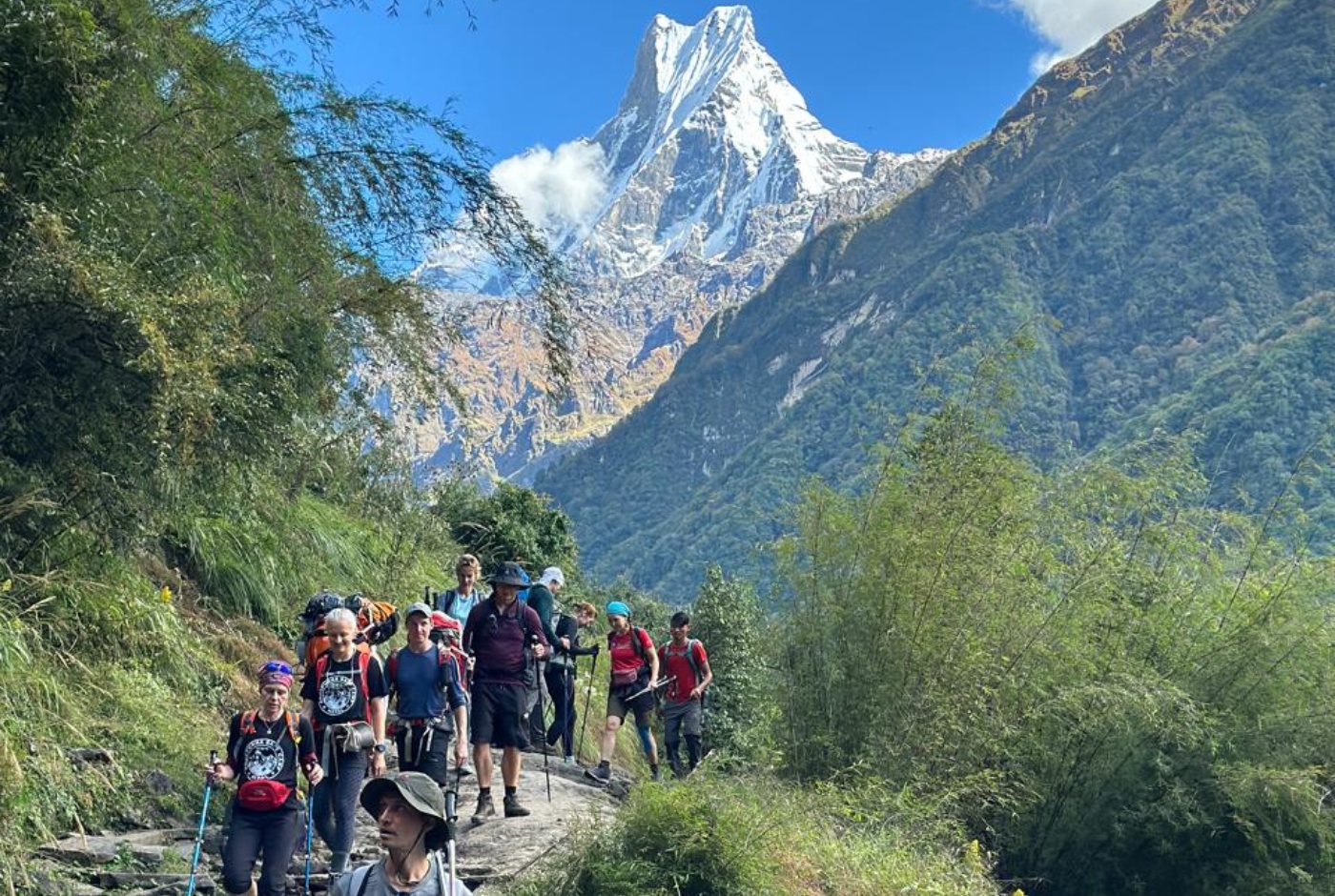
The Annapurna Base Camp Trek runs from a jeep drop-off near Pokhara through Gurung farming villages, dense forest, a river valley, and a narrow gorge that opens into the Annapurna Sanctuary at 4,130 meters.
It typically takes 10 to 13 days, depending on the starting point and pace. Understanding how the route shifts in character helps explain why each stage needs a different kind of attention from the company running it.
The Opening Days: Gurung Villages and River Paths
The first two to three days follow the Modi Khola River through warm farming villages. This is where the route's cultural richness lies, and it is also where less experienced operators make their first mistake by treating these days as a transit toward altitude.
Ghandruk at 1,940 meters is one of Nepal's best-preserved Gurung settlements. It has a local museum covering Gurung military history, stone-paved lanes, carved wooden window frames on the older houses, and teahouses with direct views of Machhapuchhre and Annapurna South.
Spending a proper evening here is worth more to the overall experience than arriving at Bamboo Lodge an hour earlier.
Between Ghandruk and Chhomrong, rhododendron forest covers the hillsides on both sides. From March through May, these slopes turn red, pink, and white with bloom. April is the densest month, and walking through here on a clear morning is genuinely one of the better visual moments on the whole trek.
For trekkers doing the Poon Hill combined route, the rhododendron section between Ghorepani and Ghandruk is encountered even before reaching Chhomrong, meaning two full stretches of forest in bloom rather than one.
Chhomrong and the Stone Steps
Chhomrong sits at 2,170 meters and is the last major Gurung village before the Sanctuary. Leaving the village toward Sinuwa involves 2,141 stone steps on a steep slope. They come up in almost every trekker review of this route because they are the most demanding stretch on the lower half, and nobody fully prepares you for them. A guide who properly manages the group's pace here protects the energy needed for the days ahead.
Bamboo Lodge to Deurali
Above Chhomrong, the forest gets quieter, and the path narrows. The trail runs through Bamboo Lodge and up toward Deurali, following the river through increasingly confined ground. Rhododendron and bamboo cover the slopes on both sides. At Deurali, the walls of Hiunchuli and Machhapuchhre close in on both sides. This is the entrance to the Sanctuary gorge, and from here, the feel of the trek shifts completely from everything below.
The Sanctuary and Base Camp
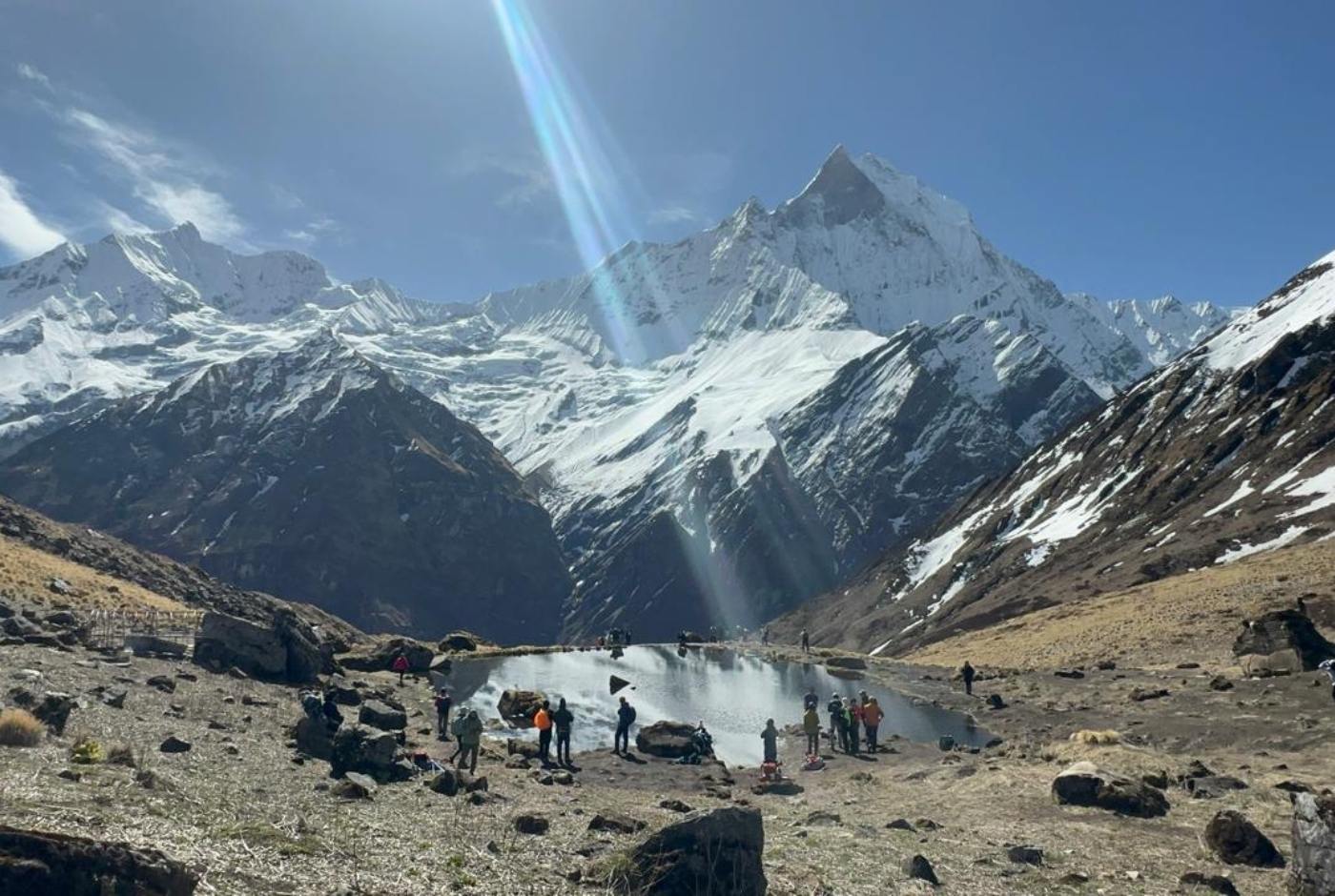
Machhapuchhre Base Camp sits at 3,700 meters below the Fishtail Peak at 6,993 meters. This mountain has never been legally summited. The government of Nepal closed it to all climbing before the only serious attempt, a British expedition in 1957, was completed. The trail passes directly below it before entering the Sanctuary basin.
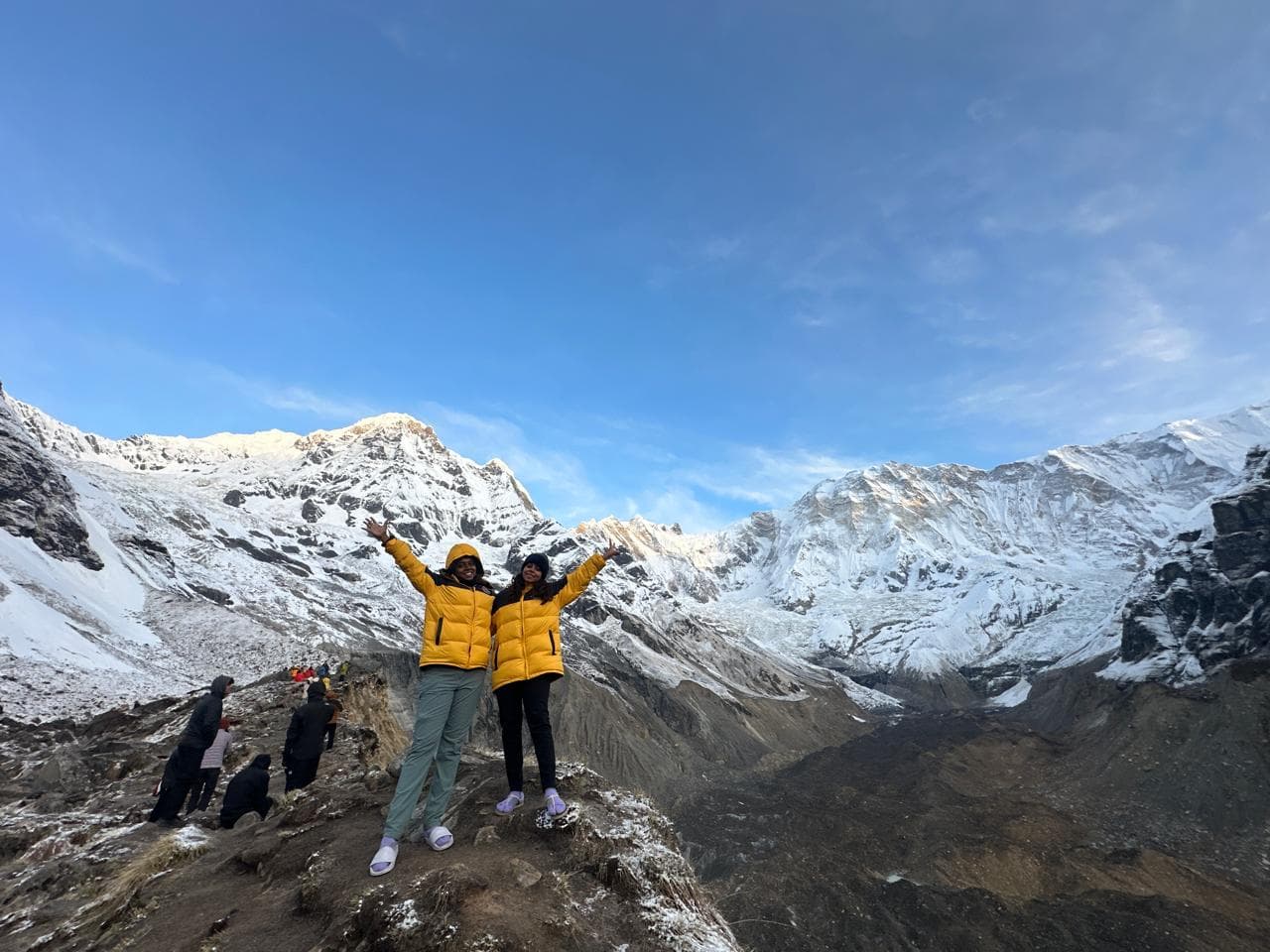
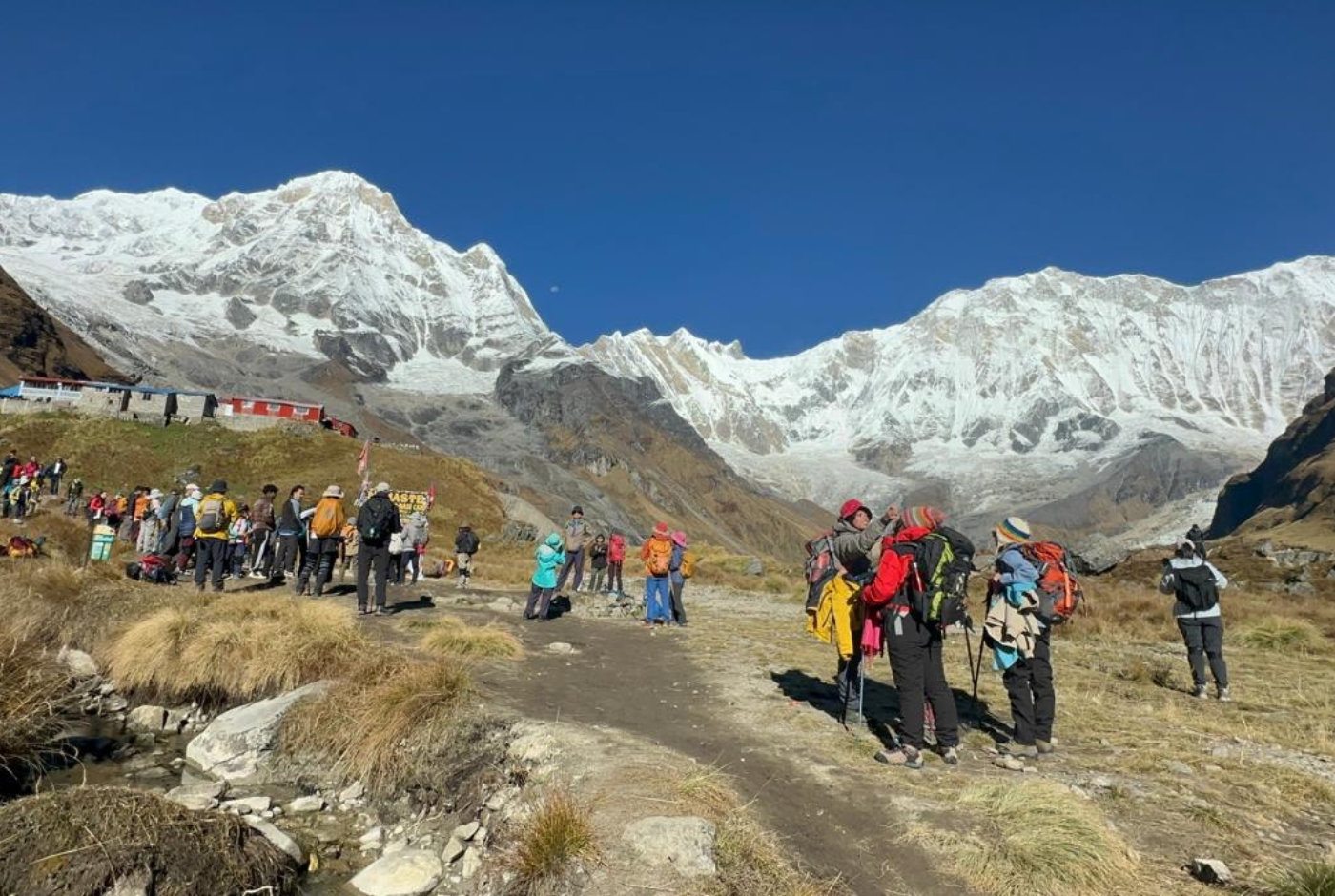
Annapurna Base Camp at 4,130 meters sits inside a ring of peaks: Annapurna I (8,091 m), Annapurna South (7,219 m), Gangapurna (7,455 m), Hiunchuli (6,441 m), and Machhapuchhre (6,993 m) form the walls.
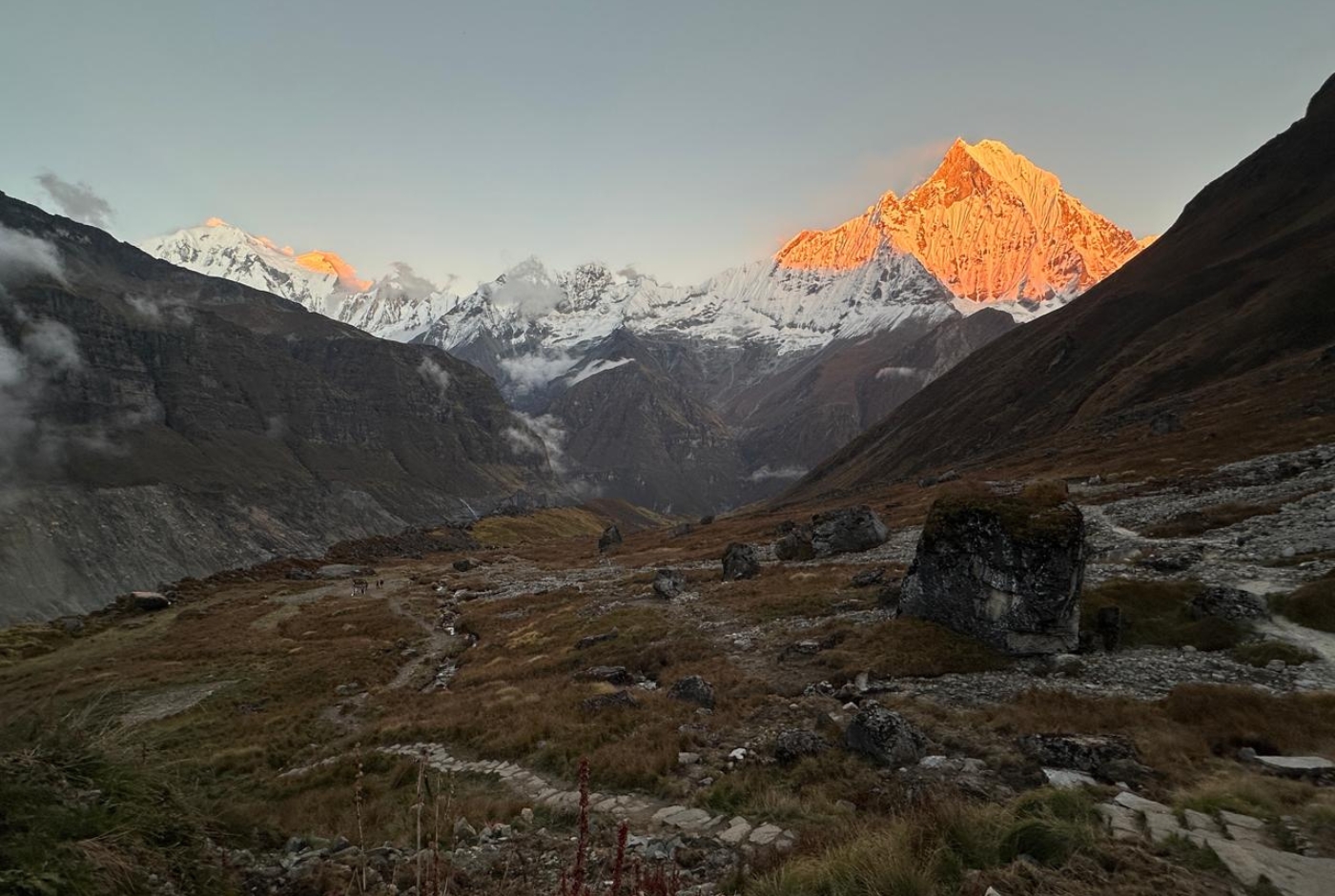
The late-afternoon light, when shadows shift across the south face of Annapurna, and glacial detail becomes visible on the surrounding peaks, is one of the better reasons to arrive early. The pre-dawn sunrise, when each peak catches the first light in sequence over about 20 minutes, is the other. Both require a well-structured itinerary, not just the right location.
Two permits are required for the trek:
- ACAP (Annapurna Conservation Area Project permit): NPR 3,000 per person, checked at Nayapul and along the trail
- TIMS card: USD 10 per person through a registered agency, USD 20 for independent trekkers
6 Questions Worth Asking Any ABC Trekking Company Before You Book
Choosing between companies offering the Annapurna Base Camp Trek is harder than it looks because the packages read similarly online. The real differences only become clear once you ask the right questions. These six cover the areas where most operators either deliver or fall short, and the answers reveal a lot about how seriously a company actually runs this route.
Question 1: Do They Know This Trek Specifically, or Just Nepal in General?
A company that runs the ABC Trek regularly knows things that a company listing it alongside fifty other packages simply does not.
Route-specific knowledge of ABC means knowing which trailhead makes sense given available days and how to time the Sanctuary entry before afternoon cloud cover closes in on the mountain views. Which teahouses at Bamboo Lodge and Deurali are worth booking across different seasons? How to manage the group pace through the Chhomrong stone steps, and when conditions above Deurali carry a higher risk, and how to respond.
Ask directly: how many ABC departures have you run in the past year? What does the guide know specifically about the Chhomrong section and the Sanctuary approach timing? What is the protocol if conditions above Deurali look unstable? The answers tell you more than any number of star ratings.
Escape Himalaya has been running the Annapurna region for close to a decade, with the 13-day Annapurna Base Camp Trek as one of the most consistently guided routes across spring, autumn, and shoulder seasons.
Question 2: How Seriously Do They Take the Cultural Sections?
The Gurung village days are not a warm-up before the altitude begins. They are a core part of why this trek has the character it does, and an itinerary that rushes through them to reach Chhomrong more quickly is a real mistake.
The Gurung people have a cultural identity distinct from that of the rest of Nepal, rooted in Tibetan Buddhism, yak herding, and a military history that dates back to the early 1800s through the Gurkha tradition. The Gurkha soldiers recruited from Gurung communities have served in the British and Indian armies for over two centuries. They are considered among the most respected fighting forces in modern military history. The museum in Ghandruk covers this through Gurkha regalia and khukuri knives, photographs, personal accounts from community members, and records going back two centuries.
Beyond the museum, Ghandruk itself rewards a proper evening. The stone paths, the vegetable gardens behind the houses, and Machhapuchhre catching the last light from the teahouse verandas are things that disappear if the itinerary treats the village as a one-night stop with an early departure.
A guide with genuine Gurung cultural knowledge does not deliver this information as a briefing at the trailhead. It comes through naturally throughout the village days, in the context around a mani wall, the explanation of a festival flag strung between houses, the story behind a particular style of carved window frame. That kind of guidance transforms the lower section from a walk toward altitude into something that makes the whole route feel more layered and earned.
Escape Himalaya's 13-day Annapurna Base Camp Trek builds proper time into both Ghandruk and Chhomrong rather than treating the cultural days as filler before the Sanctuary begins.
Question 3: How Do They Handle the Sanctuary Section Above Deurali?
Above Deurali, the path runs through glacial ground with mountain walls rising steeply on both sides. Snow is possible at any time of year above 3,500 meters. In late winter and during heavy spring snowfall, certain sections above Deurali carry a real avalanche risk on specific slopes. This is not a concern, but something experienced guides on this route factor into their early-morning departure decision from Deurali.
An experienced guide on this section reads the snow and weather conditions before entering the gorge. They know when to move early versus when to wait, and can explain the full story of Machhapuchhre. They can explain why no legal summit attempt has been completed, and what to expect between Deurali and MBC before they are already on the approach. None of this comes from a guidebook. It comes from running the route across different seasons and paying attention to what changes.
Ask any company: has your guide done this section in both spring and autumn conditions? What is the process if conditions look uncertain at Deurali?
Question 4: Is One Night at Base Camp Enough?
Most budget packages arrive at base camp in the afternoon and leave before mid-morning the next day. This technically reaches the destination. It does not deliver the experiences that make the journey worth it.
The two moments at Annapurna Base Camp that trekkers consistently describe as the highlight of the entire route are the late afternoon arrival, when shadows shift across the south face of Annapurna, and glacier detail becomes visible on Annapurna South and Gangapurna with the light changing every 10 minutes until dark, and the pre-dawn sunrise, when the sky moves from black to deep blue to orange, and each peak catches the first light in sequence, with Annapurna I typically the last to light up as the whole basin shifts through gold and white over about 20 minutes.
Both of these require a well-built itinerary, not just the right GPS coordinates. A company that arrives at base camp at 3 pm and departs at 7 am has technically been there. The experience is not the same as one who arrives at 1 pm, walks the moraine in the late afternoon, and wakes before 5 am for sunrise.
Before booking, ask any company: what time does the itinerary arrive at base camp on the relevant day, and what is specifically planned for sunrise? A vague answer here is a real signal about the operator's priorities.
Question 5: Is the Jhinu Hot Spring Actually Built Into the Return?
Jhinu Danda sits 15 to 20 minutes below the village on the bank of the Modi Khola River. Three natural mineral pools fed by geothermal heat sit beside fast-moving glacial water. After six or seven days of walking, a proper soak in these pools is one of the more genuinely restorative moments on any Nepal trek. The heat from the mineral water, combined with the cold mountain air and the sound of the river running below makes it memorable in a way that is completely different from the mountain scenery above.
Many operators route the return through Jhinu but do not build enough time there. Trekkers arrive at the pools, spend 15 minutes, and get back on the trail because the jeep is already waiting at the bottom. This is entirely avoidable with a half-hour of planning in the itinerary.
Before booking, ask specifically: is the Jhinu hot spring visit built into the itinerary with enough time for a proper stop, or does it just appear on the route map? The difference between those two things is significant. Escape Himalaya makes Jhinu a real stop on the return day, not a passing reference.
Question 6: What Does the Package Actually Include at Both Ends?
The ABC Trek starts from Pokhara, not Kathmandu. A complete package needs to account for the Kathmandu to Pokhara journey, accommodation in both cities, and the jeep transfer from Pokhara to the trailhead. These are the items most commonly missing or quietly excluded from cheaper packages, and they add up fast when charged separately.
A complete ABC package should include:
- Airport transfers in Kathmandu
- 3-star hotel in Kathmandu before and after the trek
- Kathmandu to Pokhara flight or tourist bus
- 3-star hotel in Pokhara before and after the trek
- Jeep from Pokhara to the trailhead and return
- All meals during the trek (breakfast, lunch, and dinner)
- ACAP permit (NPR 3,000 per person) and TIMS card (USD 10 through a registered agency)
- Licensed government guide and porter
- Sleeping bag and down jacket loan
- Trek completion certificate
Common gaps in budget packages:
- Pokhara hotel listed as an optional extra
- Kathmandu to Pokhara transport is charged separately after booking
- Permits are excluded from the headline price and added on request
- Porter's fee is added only when specifically asked
- Gear loans are unavailable or charged as extras
Personal trail expenses for Wi-Fi, hot showers, snacks, charging, and guide and porter tips typically run USD 150 to 200 for the full duration.
The Gurung Villages: What the Cultural Section Adds to the Route
Every Nepal trek passes through villages. The ABC Trek passes through Gurung villages specifically, and that is a more meaningful distinction than most booking pages make clear. The Gurung community has lived in the Annapurna foothills for centuries. Their culture along this route is layered, specific, and worth understanding before you walk through it.
Ghandruk
Ghandruk at 1,940 meters is the cultural heart of the lower route. The local museum covers Gurung military history in depth, including the Gurkha tradition that brought Gurung men into the British and Indian armies from the early 1800s onward. The khukuri knife, the curved-bladed weapon carried by Gurkha soldiers, is displayed alongside photographs, personal accounts from community members, and records dating back two centuries.
Outside the museum, the village has a character that no other part of the route replicates. Stone-paved lanes, carved wooden window frames on the older houses, and teahouses facing directly toward Machhapuchhre and Annapurna South. A proper evening here, rather than passing through to make time, is one of the better decisions on the ABC Trek.
Chhomrong
Chhomrong, at 2,170 meters, has been hosting trekkers for decades, and the lodge families know the mountain well. The food is reliably good. The views of Annapurna South from the upper part of the village on a clear evening are among the best anywhere on the route. And then the 2,141 stone steps leading toward Sinuwa are there waiting the next morning, steep and unavoidable. A guide who paces the group through this section correctly protects the energy needed for everything above.
Cultural Details Worth Knowing Before You Go
- Tamu Lhosar: The Gurung New Year, celebrated in mid-January with Panche Baja traditional music, community dancing, and family gatherings from across the region
- The Rodhi: A traditional social gathering house where young Gurung men and women meet through song and storytelling, specific to this community
- Traditional clothing: The Gurung topi, cholo blouse, pangra wrap skirt, and heavy silver necklaces worn at festivals and ceremonies by the older generation
- The rhododendron bloom: From March through May, the hillsides between Ghorepani, Ghandruk, and Chhomrong turn red, pink, and white. The densest flowering is in April. Trekkers combining Poon Hill with the ABC walk through two separate stretches of this forest, which makes a spring departure considerably more rewarding than the same route in winter or summer.
Poon Hill and Annapurna Base Camp: Two Viewpoints That Work Better Together
Most people planning a trip to the Annapurna region eventually ask whether to do Poon Hill or Annapurna Base Camp. Once you understand what each actually offers and how they connect on the ground, the question mostly answers itself.
Poon Hill sits at 3,210 meters in the Ghorepani area. The sunrise view from the top on a clear morning covers Dhaulagiri at 8,167 meters, Annapurna I at 8,091 meters, Annapurna South at 7,219 meters, Annapurna II at 7,937 meters, Annapurna III at 7,555 meters, Machhapuchhre at 6,993 meters, Nilgiri at 7,061 meters, Tukuche Peak at 6,920 meters, and Lamjung Himal at 6,931 meters across nearly 180 degrees of horizon. At sunrise, the light moves across the range from east to west, peak by peak, over about 20 minutes. Dhaulagiri catches it first. Annapurna I typically lasts.
From Poon Hill, you are looking at the Annapurna range from a distance. From Annapurna Base Camp, you are inside the range at 4,130 meters, looking up at the same mountains from directly below. What looks like a broad mountain landscape from Ghorepani becomes the walls surrounding the camp at base camp. Doing both in the same trip means experiencing the Annapurna range in two completely different ways, and trekkers who have done the combined route consistently say the Poon Hill sunrise section gave the base camp arrival a context it would not have had otherwise.
There is also a practical reason to do Poon Hill before base camp, not just an experiential one. Spending a night in Ghorepani at 2,855 meters gives the body a gradual adjustment to altitude before the Sanctuary section. For first-time high-altitude trekkers especially, this natural acclimatization step makes the push to 4,130 meters considerably more comfortable than heading straight up from Pokhara without that night at elevation.
The Practical Details of Poon Hill
- Walk from Ghorepani to the viewpoint: 45 minutes in the dark on a well-worn path
- Typical start time: between 4:30 and 5:00 am, depending on the season
- A headlamp is needed for the walk up
- As of 2026, a direct jeep road connects Pokhara to Ghorepani in around 4 hours in a 4WD vehicle, making the Poon Hill section far more time-efficient than it was a few years ago, when it required an extra day of walking from Nayapul
What to Ask Any Operator About the Poon Hill Section
The quality of the Poon Hill experience depends more on the operator's planning than the viewpoint itself. Before booking, ask:
- Is the 4:30 am sunrise walk managed by the guide, or left for trekkers to do independently?
- What is the plan if heavy cloud cover arrives the night before the planned sunrise morning? Is there a backup day built in?
- Is Ghandruk included on the return from Poon Hill, or does the itinerary skip the village to save time?
The last question is worth pressing on. Ghandruk, on the return from Poon Hill, is where some of the better views of the route happen and where the Gurung cultural experience gets a second, fuller layer. An operator who removes it to shorten the itinerary is prioritizing pace over the reason most people come to this part of Nepal.
ABC and Poon Hill Trek Options From Escape Himalaya
The range of ABC and Poon Hill options from Escape Himalaya covers different timelines, fitness levels, and priorities. No single package fits everyone, and knowing which option suits your available time is worth thinking through before booking.
- For 13 to 14 days: The Annapurna Base Camp Trek (13 Days) is the full route. Complete Ghandruk cultural section, full Sanctuary approach, a properly timed base camp experience including sunrise, and the Jhinu hot spring return. Every section gets the time it deserves.
- For 9 days: The Short Annapurna Base Camp Trek (9 Days) starts from a closer trailhead and keeps the core Sanctuary and base camp experience while tightening the return. Works for trekkers with fixed travel windows who cannot spend two full weeks.
- For Poon Hill combined with ABC: The Poon Hill ABC Short Trek (11 Days) adds Ghorepani and the Poon Hill sunrise to the base camp route in a single itinerary. The Poon Hill section provides natural acclimatization before the Sanctuary, making the altitude at base camp more manageable for first-time high-altitude trekkers. This is one of the most complete ways to experience the Annapurna region in under two weeks.
- For Poon Hill as a standalone: The Poon Hill Trek (8 Days) covers the Ghorepani circuit through the Gurung villages, with the sunrise as the main event. The most accessible Annapurna region option in the portfolio, suited to most fitness levels and shorter travel windows.
- For the Annapurna Circuit comparison: The Annapurna Circuit Trek (14 Days) is longer, reaches a higher altitude at Thorong La Pass at 5,416 meters, and covers more ground across the circuit. The ABC Trek is more compact, richer in the Gurung village sections, and ends at a base camp rather than a pass crossing. Both are worthwhile and genuinely different from each other.
- For a quieter alternative in the same region: The Mardi Himal Trek uses a less-traveled route with smaller groups and very close views of Machhapuchhre. Worth considering for trekkers returning to the Annapurna region or those who want fewer people on the trail during peak season.
What Escape Himalaya Brings to the ABC Trek
Across close to a decade of running the Annapurna region, Escape Himalaya has built a level of route-specific depth on the ABC Trek that is worth being specific about:
- Full registration with NTB, TAAN, and NMA, with legal documents available on the website for anyone to verify before booking
- Both the ACAP permit and the TIMS card are managed before arrival, with no extra coordination needed from the trekker
- Guides with genuine Annapurna-specific knowledge covering Gurung cultural context, Chhomrong stone step pacing, Sanctuary entry timing, Machhapuchhre history, and base camp sunrise structure
- Complete packages covering airport transfers, Kathmandu 3-star hotel, Kathmandu to Pokhara transport, Pokhara hotel, jeep to trailhead, all trek meals, permits, guide, porter, sleeping bag, down jacket, and trek completion certificate
- Jhinu hot spring is built into the return as a proper stop with enough time actually to use it
- Minimum group size of 1 person, so solo trekkers can book a private departure without waiting for a group
- Five Annapurna region trek options from 8 to 14 days covering different budgets, timelines, and priorities
- TripAdvisor Certificate of Excellence 2025, listed on TourRadar and Viator, with ABC-specific reviews across multiple seasons
- 24/7 WhatsApp support throughout the trek: Raj at +977-9851006121 and Suman at +977-9851363580
Honest Answers to the Questions Trekkers Ask Before Booking
Is Annapurna Base Camp suitable for beginners?
Yes. At 4,130 meters, it is the most accessible high-altitude base camp trek in Nepal. Daily stages run 5 to 7 hours on well-marked paths with teahouse accommodation at every stop. The Chhomrong stone steps are the most physically demanding stretch of the route, and a good guide manages the pace there in particular. For beginners especially, combining Poon Hill with ABC gives the body an extra night at altitude before the Sanctuary, which makes the push to base camp considerably more comfortable.
How many days do I actually need?
Nine is the minimum for a meaningful experience. Thirteen days give the cultural sections and the Sanctuary proper time without pressure. The lower Gurung village days are not a warm-up. They are a core part of what makes this route worth doing rather than a faster alternative.
Does Poon Hill help with acclimatization before base camp?
Yes, practically. Spending a night in Ghorepani at 2,855 meters gives the body a gradual adjustment to altitude before the Sanctuary section begins. Trekkers who do Poon Hill first consistently report handling the altitude at base camp more easily than those who head straight up from Pokhara. For first-time high-altitude trekkers, this is a real consideration, not a marketing angle.
What is the best season?
Spring (March to May) for rhododendron bloom and warm walking conditions in the forest sections. Autumn (September to November) for the clearest mountain views and most stable weather at base camp. Both work well for ABC. Spring gives a better experience in the lower and middle sections. Autumn gives the better base camp mornings.
What if the weather is bad at base camp?
A well-run itinerary builds a buffer day in for exactly this reason. Before booking, ask whether the schedule has flexibility around the base camp days or whether a cloudy morning means simply missing the sunrise entirely.
Do I need to be fit for the Chhomrong stone steps?
The 2,141 steps are steep and completely unavoidable on the standard route. They are not technical, but they require steady legs and a managed pace. A good guide handles this section specifically, and the group always feels better for the pacing by the time they reach Sinuwa.
Plan Your Annapurna Base Camp Trek With Escape Himalaya
The ABC Trek gives back more when the whole route is taken seriously. The Gurung villages in the opening days, the rhododendron slopes in spring, the stone steps at Chhomrong, the quiet of the Sanctuary at night, the sunrise at base camp, and the Jhinu hot spring on the way back each add something distinct.
Poon Hill, done before base camp, connects the distant mountain panorama to the close-up experience inside the Sanctuary in a way that makes both more meaningful.
Choosing a company that understands the full route from the first day to the last jeep ride back to Pokhara is the difference between a trip worth remembering and one that simply reaches base camp and returns.
Escape Himalaya has been running the Annapurna region for close to a decade, with ABC and Poon Hill among the most consistently guided routes in the portfolio.
Bookings for 2026 and 2027 are open now. Explore all ABC and Annapurna region options at escapehimalaya.com or reach out on WhatsApp at +977-9851006121 (Raj) or +977-9851363580 (Suman). The contact page is available for detailed trip planning.