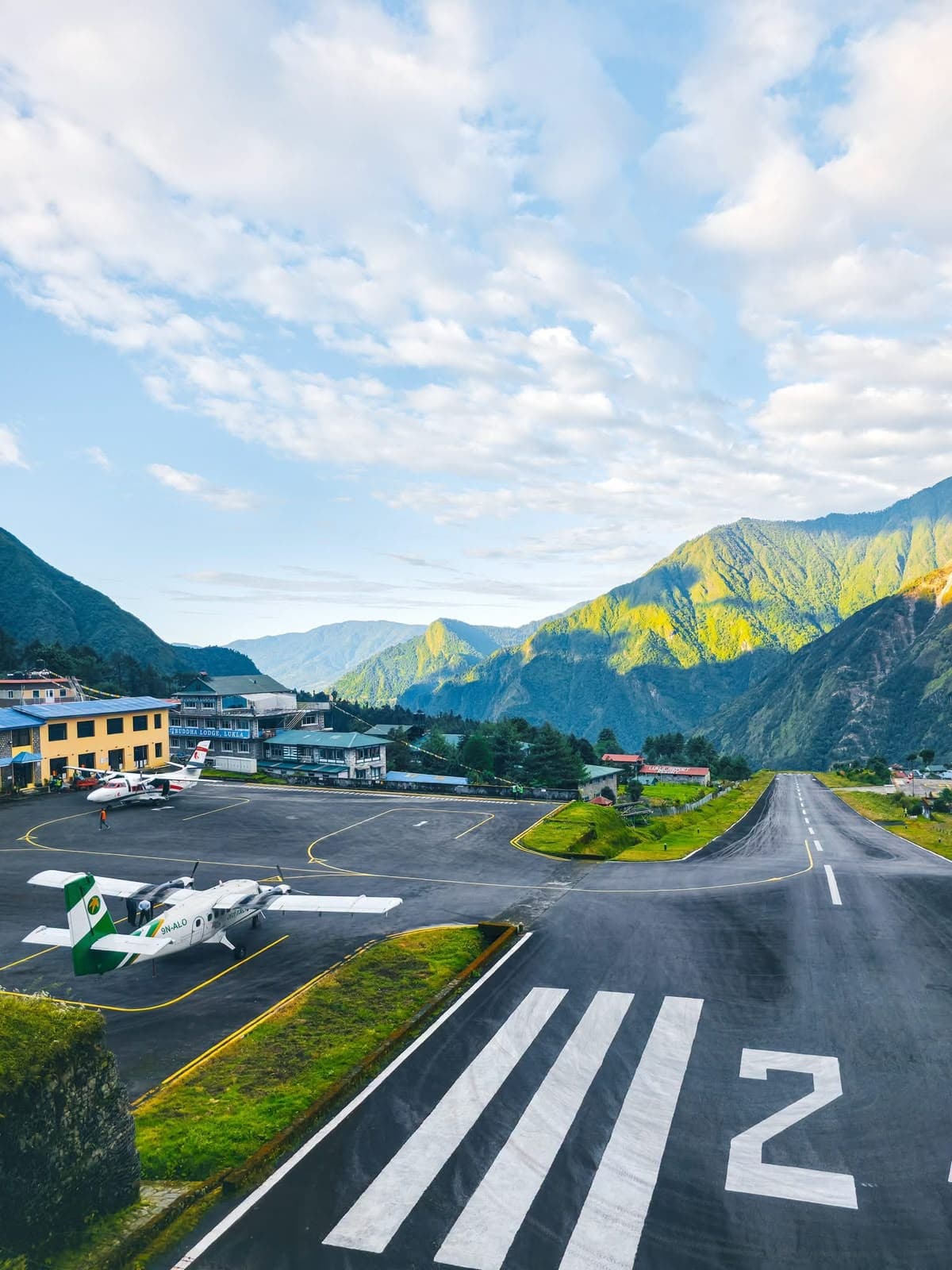
Fly into Tenzing Hillary Airport in Lukla, one of the most dramatic mountain landings in the world
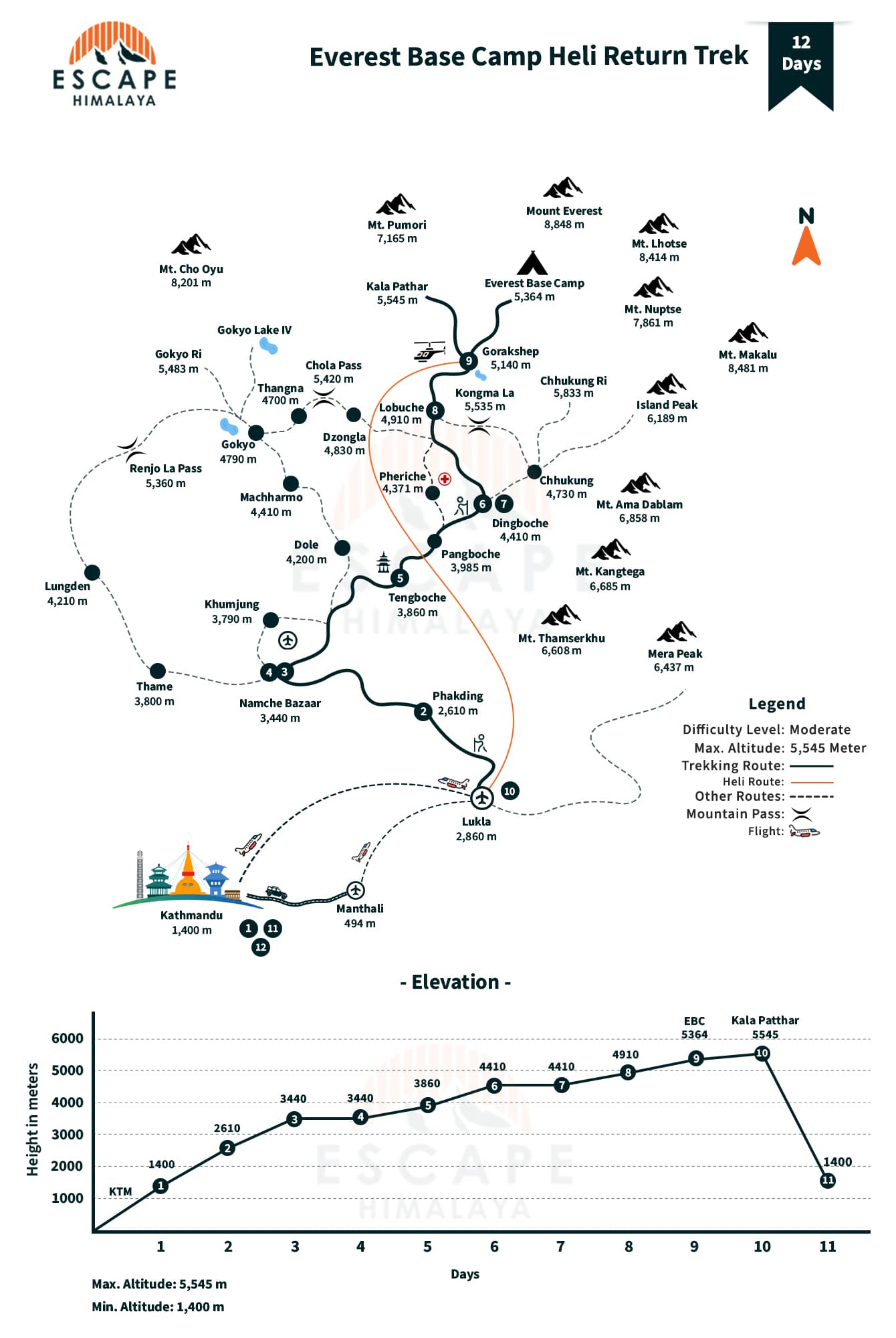
Walk the legendary Khumbu trail through Phakding, Namche Bazaar, Tengboche, Dingboche, and Lobuche
Spend two nights in Namche Bazaar (3,440 m), the cultural and commercial heart of the Sherpa community
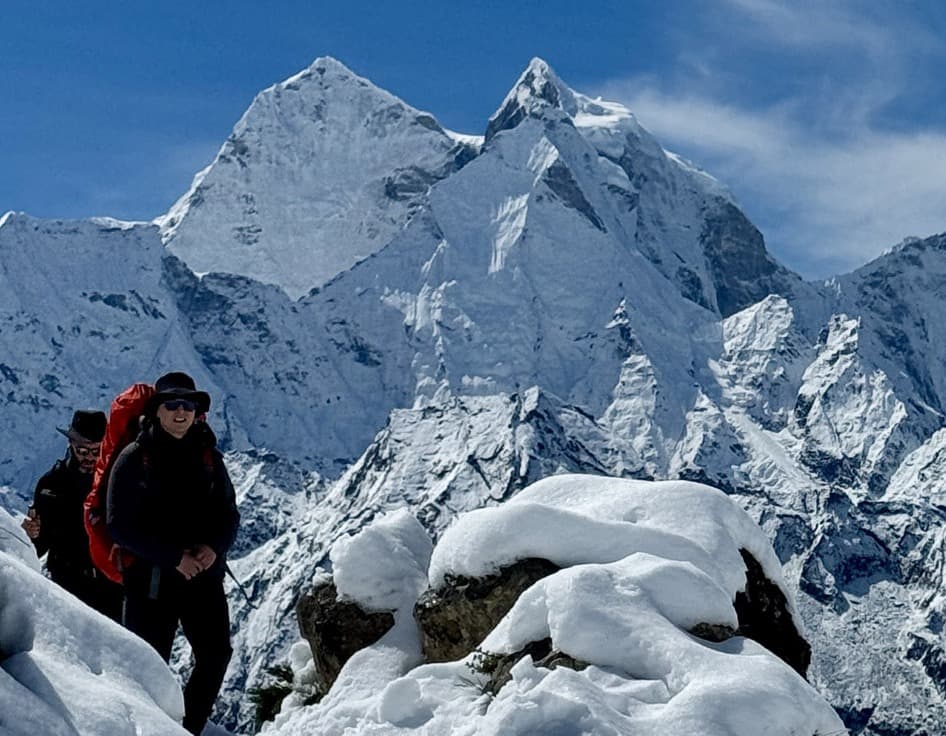
Hike to Nagarjun Hill at 5,100 meters from Dingboche for sweeping views of Makalu, Ama Dablam, and Lobuche
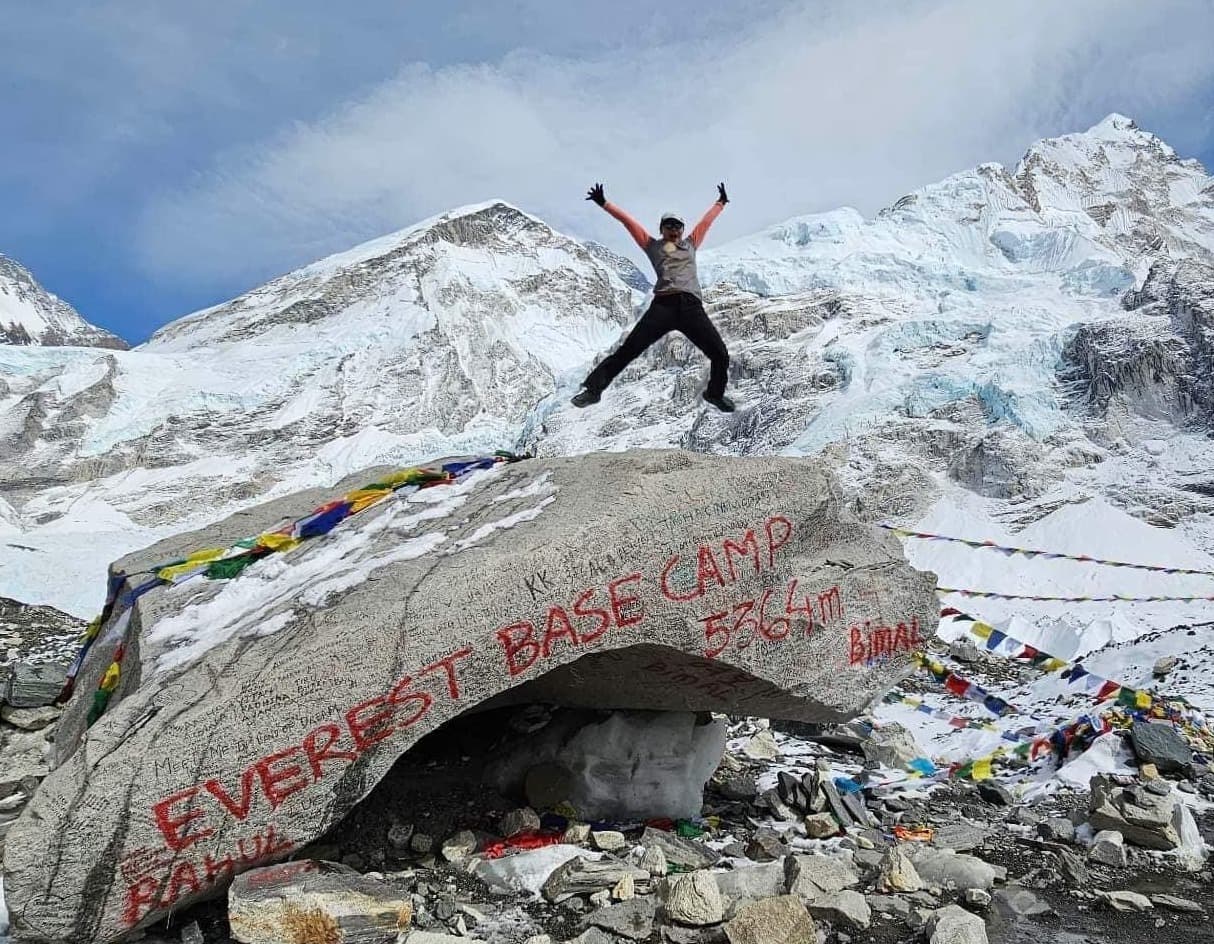
Stand at Everest Base Camp at 5,364 meters beneath the Khumbu Icefall with Annapurna I, Lhotse, and Nuptse surrounding you
Summit Kala Patthar at 5,545 meters before dawn for the most complete sunrise view of Mount Everest available on any Nepal trek
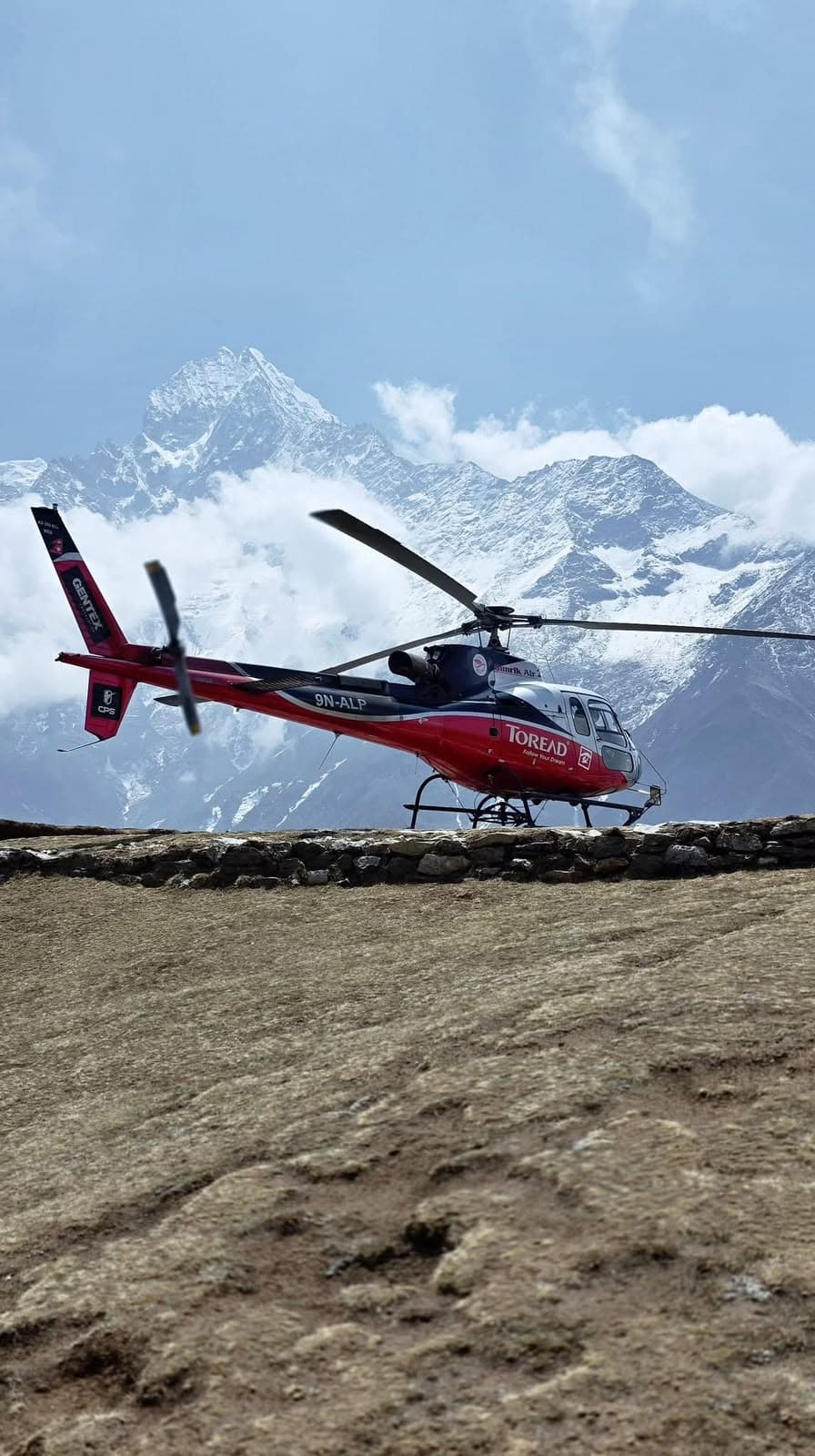
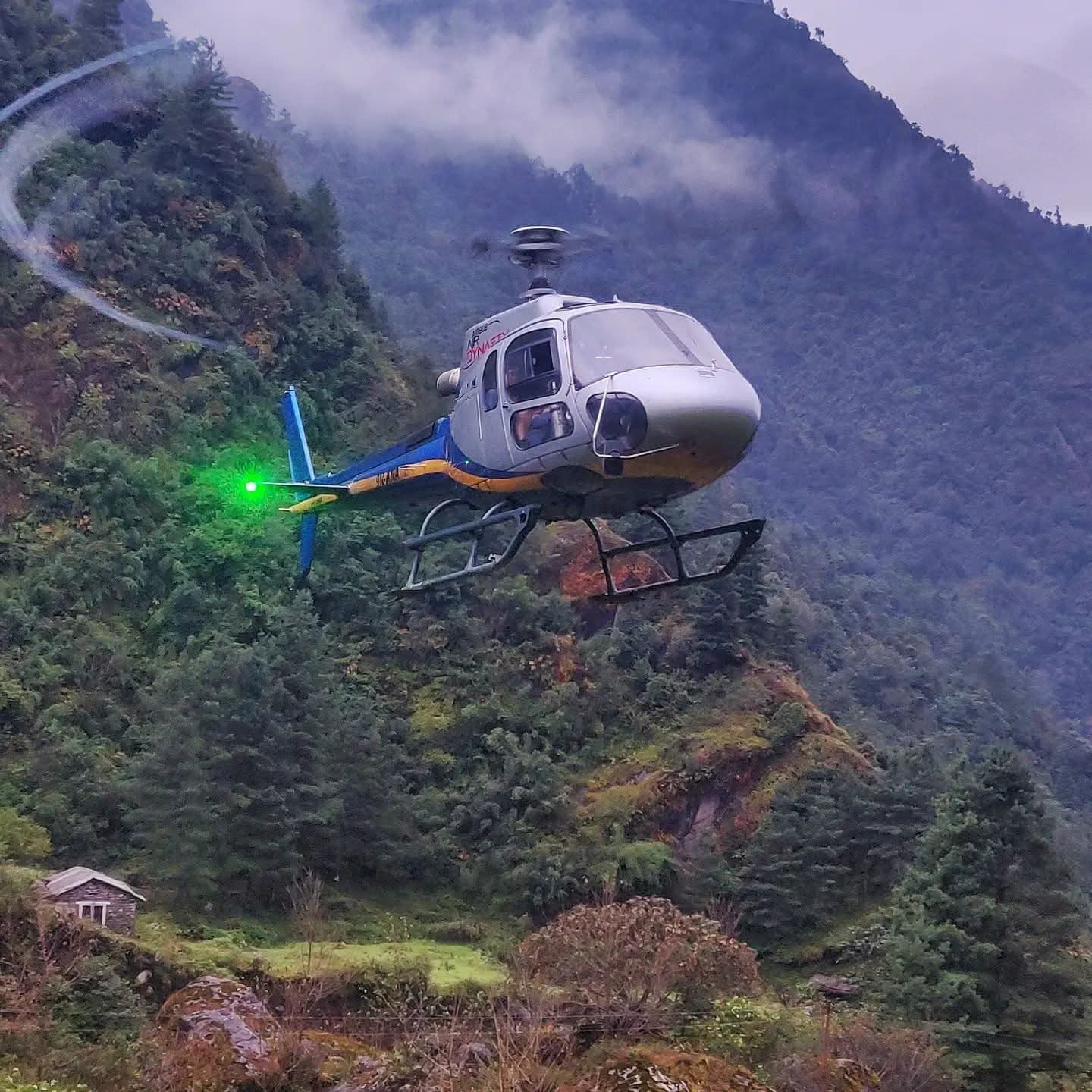
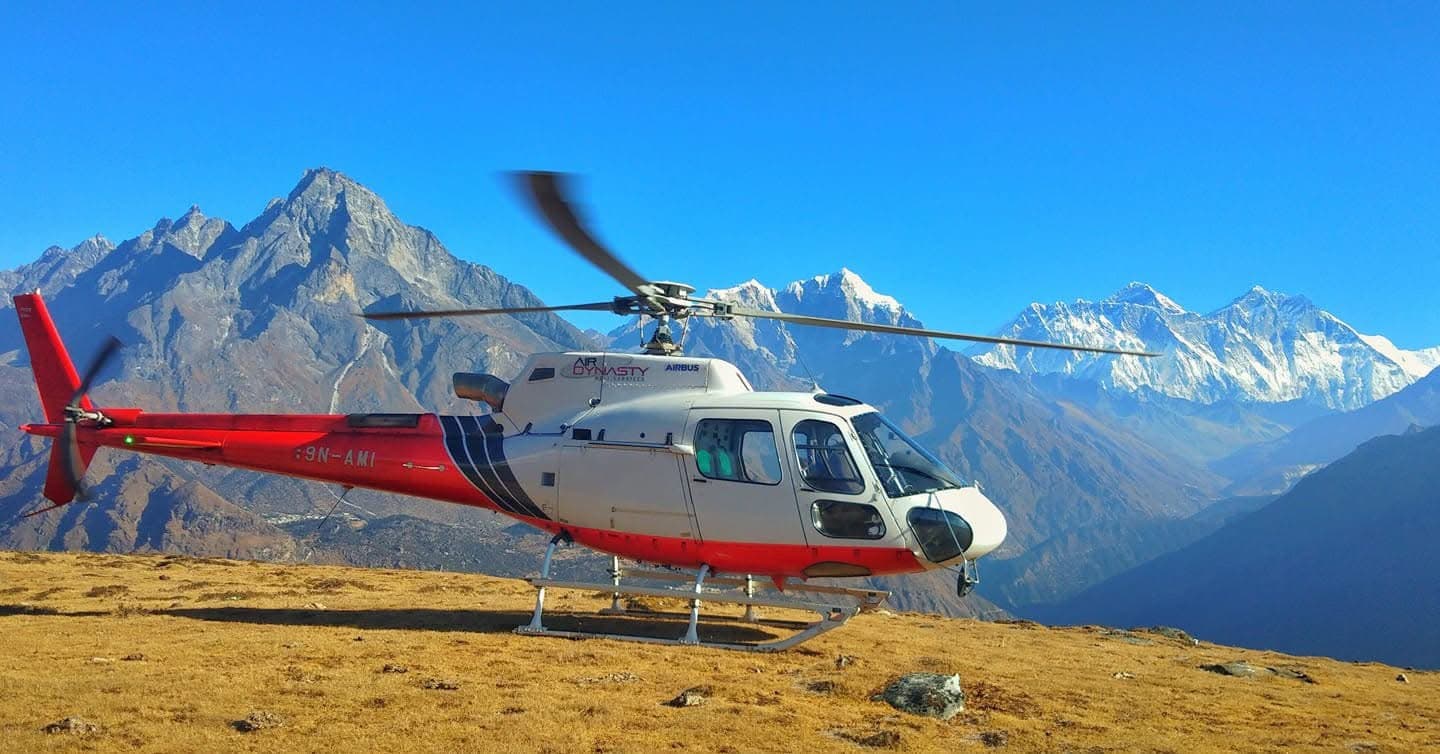
Fly back from Gorakshep to Lukla by helicopter, covering in 15 to 20 minutes what takes 3 to 4 days on foot
Watch the Khumbu Glacier, the icefall, and the full ring of 8,000-meter peaks from the air on the return flight
Visit Tengboche Monastery, the oldest and most significant Buddhist monastery in the Khumbu region
Save 3 to 4 trekking days on the return while gaining an aerial view of the Himalayas that no ground-level trail delivers
Overview
The Everest Base Camp Heli Shuttle Trek is for trekkers who want the full Khumbu experience on the way up and a spectacular 15-minute helicopter flight on the way back. You walk the entire classic EBC route through Namche Bazaar, Tengboche, Dingboche, and Lobuche, reach Everest Base Camp at 5,364 meters, and then summit Kala Patthar at 5,545 meters before dawn for the best sunrise view of Everest on any trekking route in Nepal. Instead of spending 3 to 4 days retracing the same trail back to Lukla, a shared helicopter from Gorakshep brings you back in roughly 15 to 20 minutes.
The helicopter return is not just a time-saver. Flying over the Khumbu Glacier and icefall gives you a perspective on the terrain that is simply not possible from the ground. The crevasses in the icefall, the flow lines of the glacier, the way the peaks of Everest, Lhotse, Nuptse, Ama Dablam, and Pumori connect across the range, all of it becomes visible from the air in a way that changes how you understand what you just walked through.
This is a shared helicopter, not a private charter. At altitudes above 4,500 meters, helicopters at Gorakshep can take off with a maximum of three passengers per shuttle due to the thin air. If the group has more than three people, the first shuttle carries three passengers to a lower point, typically Pheriche, and the second shuttle collects the remaining passengers from Gorakshep before picking up the first group and continuing to Lukla. For trekkers who want a private charter, Escape Himalaya can arrange this at an additional cost. The 12-day itinerary is built around proper acclimatization with rest days at Namche Bazaar and Dingboche. Two permits are required: the Sagarmatha National Park Entry Permit (NPR 3,000 per person for foreign trekkers) and the Khumbu Pasang Lhamu Rural Municipality Fee. Both are included in the Escape Himalaya package. The minimum group size for this trek is two people, which is specific to the helicopter sharing logistics.
Route Overview: Day-by-Day Trail From Lukla to Gorakshep
The Everest Base Camp Heli Shuttle Trek covers the full classic Khumbu corridor on foot before the helicopter return takes over. The route runs from Lukla through Phakding, Namche Bazaar, Tengboche, Dingboche, and Lobuche before the final push to Everest Base Camp and Kala Patthar.
The flight into Lukla at 2,860 meters takes 30 to 40 minutes from Kathmandu, or 15 to 20 minutes from Ramechhap during peak season. From Lukla, the trail follows the Dudh Koshi River through pine forests and Sherpa villages to Phakding at 2,652 meters, covering 8 kilometers in about 3 hours and crossing several suspension bridges along the way. The next day, the trail leaves Phakding and enters Sagarmatha National Park at the Monjo checkpoint before the steep 600-meter climb to Namche Bazaar at 3,440 meters. The first views of Everest appear above the ridge at Hillary's View Point on this section. The walk covers 10 to 12 kilometers over 6 hours.
The acclimatization day at Namche is an active one. The day hike to Everest View Hotel at 3,880 meters takes about 3 hours round trip and delivers views of Everest, Ama Dablam, Lhotse, Nuptse, Thamserku, and Kongde Ri on a clear morning. Namche itself has a museum covering the 1953 Everest expedition, a Saturday market, bakeries, and teahouses that make the two nights here genuinely enjoyable rather than just necessary.
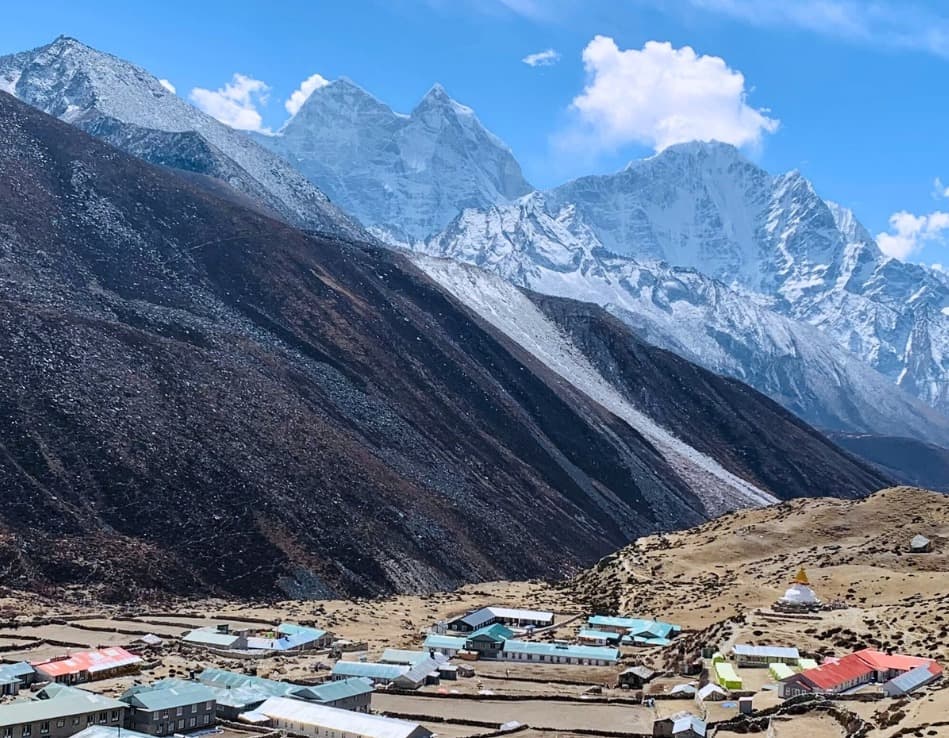
From Namche, the trail drops into the Dudh Koshi valley at Phunki Tenga before climbing through rhododendron and juniper forest to Tengboche at 3,860 meters. The Tengboche Monastery, the most significant Buddhist monastery in the Khumbu, sits on the ridge with a direct view of Ama Dablam and the Everest massif. Monks hold prayer sessions morning and evening and visitors are welcome. The walk covers 10 to 11 kilometers over 5 hours. The trail then passes through Pangboche at 3,900 meters, crosses the Imja Khola, and reaches Dingboche at 4,410 meters, known locally as the Summer Valley for the wide open bowl of farmland and mountain views it sits in. This day covers 11 to 12 kilometers over 6 hours.
The second acclimatization hike goes from Dingboche to Nagarjun Hill at 5,100 meters, covering 5 to 6 kilometers round trip over 6 hours. The views from the top include Makalu at 8,463 meters, Ama Dablam at 6,856 meters, Lobuche East at 6,119 meters, and Taboche at 6,367 meters. From Dingboche, the route continues to Lobuche at 4,910 meters, passing through Thukla at 4,620 meters where stone memorials at the top of the pass mark climbers who have died on Everest, including members of the 1996 disaster. The walk to Lobuche covers 11 to 12 kilometers over 6 hours.
The walk from Lobuche to Gorakshep at 5,181 meters follows the edge of the Khumbu Glacier before the trail to Everest Base Camp at 5,364 meters crosses glacial terrain and moraine. During climbing season, the expedition tents are visible on the glacier from Base Camp and the Khumbu Icefall sits directly above. The full day covers 14 to 15 kilometers over 8 hours. The final trekking day starts at 4am. Kala Patthar at 5,545 meters is the highest point of the entire trek and the best sunrise view of Everest's south face on any Nepal trekking route. Everest, Lhotse, Nuptse, Changtse, Pumori, and Ama Dablam are all visible in a full 360-degree panorama. After returning to Gorakshep for breakfast, the helicopter takes off for Lukla, covering in 15 to 20 minutes what would take 3 to 4 days on foot, with the Khumbu Glacier and icefall visible from the window throughout the flight.
Alternative Routes
Escape Himalaya Trek also operates Everest Base Camp Heli Trek, a journey that includes a helicopter return to Kathmandu from Gorakshep. You can also pick our Gokyo Lake Trek for a less expensive trip to the sapphire Gokyo Lakes of the Everest Himalayas. At the same time, the 14-day Everest Base Camp Short Trek promises a beautiful time in the Khumbu Himalayas and its cultural element. All in all, any endeavor in Khumbu Valley is a magnificent and fascinating experience.
Detail Itinerary
Expand all +
1Day 01
Arrival at Tribhuwan International Airport, Kathmandu
Upon arrival, one of our representatives will help you transfer to the trip hotel from the airport. We have no plans or scheduled events for the day, so unwind and get rested at the hotel. And you may enjoy the remaining part of the day by doing whatever you like.
Breakfast Included.
Max. Elevation:1335m.
2Day 02
Fly To Lukla And Trek To Phakding (2,652m/8,699ft) (Walking Distance: 8 km), Duration: 3 Hours
Today you will wake up early in the morning to take a flight to Lukla, which is splendid and thrilling at the same time. Since Lukla flights are pretty sensitive to unfavorable weather, you must take an early flight. After reaching Lukla, we will take our bags and hit the trail toward Phakding.
Overnight at Guesthouse. Breakfast, Lunch, and Dinner are included.
Max. Elevation:2800m.
3Day 03
Phakding To Namche Bazaar (3,440m/11,283ft) (Hiking Distance: 10 to 12 km), Duration: 6 Hours
Leaving the small settlements of Phakding, we will head towards for busy town of Namche Bazaar. Namche Bazaar once used to be a trendy and busy trading hub between Tibet and Nepal. During the journey, you can see the first view of Mt. Everest above Namche Bazaar. With Mt. Everest, the village also offers grand views of other majestic mountains such as Thamserku, Kongde Ri, Lhotse, Nuptse, Ama Dablam, etc. You will spend two days in Namche Bazaar, one of the villages stationed for acclimatization.
Overnight at Guesthouse. Breakfast, Lunch, and Dinner are included.
Max. Elevation:3440m.
4Day 04
Acclimatization at Namche Bazar, Trek to Everest View Hotel (3,880m/12,725ft) (Walking Distance: 3 to 4 km), Duration: 3 Hours
We shall use this rest day for short hikes around Namche Bazaar. The town is full of sights and perfect places for short hikes. There are museums, photo galleries, and parks to explore. You may also hike to Everest View Hotel for a grand view of Mt. Everest. Or else, you can do nothing and stroll around the town exploring the small cafes and restaurants.
Overnight at Guesthouse. Breakfast, Lunch, and Dinner are included.
Max. Elevation:3880m.
5Day 05
Namche To Tengboche (3,860m/12,660ft) (Walking Distance: 10 to 11 km), Duration: 5 Hours
We will proceed with the journey to Tengboche today. The uniform and simple path drives us towards the perspective of Mount Everest, slipping profoundly into the Dudh Koshi Valley at Phungki Thanka. Starting here, it climbs the correct flank of the Dudh Koshi valley to the Tengboche Monastery (3,860m). The town of Tengboche is considered the otherworldly focal point of the Khumbu. The trip is extensive, yet lovely perspectives of Mt. Ama Dablam and Everest ranges more than sufficiently repay it. The perspectives on the mountain tops from Tengboche's edges also are incredible. Rhododendrons and pine timberlands encircle the town, and we can see the Danphe fledgling in the forested areas.
Overnight at Guesthouse. Breakfast, Lunch, and Dinner are included.
Max. Elevation:3860m.
6Day 06
Tengboche To Dingboche (4,410m/14,464ft) (Walking Distance: 11 to 12 km), Duration: 6 Hours
Plunging through lovely timber woods and crossing the Imja Khola, we will reach the village of Pangboche at 3,900m. Today is the most intriguing traveling day since you won't lose height like on different days. You can likewise appreciate the perspectives of Mt. Lhotse, Ama Dablam, and numerous tops along the path. The course proceeds through fields to Dingboche, known as the "Midyear Valley." It has a kilometer-long divider based on the edges of the town that fills in as an assurance for the horticultural yields against the virus winds of the area. It gets more daylight also. The planted crops in the town roll gently against the mountain air.
Overnight at Guesthouse. Breakfast, Lunch, and Dinner are included.
Max. Elevation:4410m.
7Day 07
Hike To Nagerjun Hill (5,100m/16,728ft) And Return To Dingboche (Walking Distance: 5 to 6 km), Duration: 6 Hours
This is the second and last rest day at Dingboche. So we will go for a small hike to Nagarejun hill to utilize a free day. It is a small hill offering a splendid view of the mountains and is the perfect spot for a free day. Similarly, this hike will even help to accommodate changing and increasing temperatures. You will see the glorious view of the world's fifth-highest mountain- Mt. Makalu (8,463m), from the hill. Additionally, Thamserku (6,608m), Lobuche West (6,145m), Taboche (6,367m), Lobuche East (6,119m), and Ama Dablam (6,856m) are also visible. Following the hike and appreciating the all-encompassing view, we will return to Dingboche.
Overnight at Guesthouse. Breakfast, Lunch, and Dinner are included.
Max. Elevation:5100m.
8Day 08
Dingboche To Lobuche (4,910m/16,105ft) (Walking Distance -11 to 12 km), Duration: 6 Hours
We will traverse through Trekkers Aids Post on the Pheriche (4,240 m). We will then walk along a broad valley floor to Dughla. We will gain altitude by continuing up the valley so approach the journey carefully. From the valley, we go down to the Lobuche yak pastures.
Overnight at Guesthouse. Breakfast, Lunch, and Dinner are included.
Max. Elevation:4910m.
9Day 09
Lobuch To Everest Base Camp (5,364m/17,594ft) And Return To Gorakshep (5,181m/16,994ft) (Walking Distance - 14 to 15 km), Duration: 8 Hours
After a short move through the meadows, you can peer down at the Khumbu ice sheet. Straight ahead untruths Kala Patthar – the best vantage highlight see the whole south face of Mt. Everest and the encompassing pinnacles. After two or three hours, we will get to Gorakshep and continue our excursion to the Everest Base Camp. There isn't a lot of rise gain, yet there are many good and bad times, and, combined with elevation, this can be a debilitating trip. Yet, the excursion is justified, despite all the trouble. After 3 hours of walking, you will appear at the base camp. You can likewise appreciate an eminent perspective on the Khumbu ice sheet and icefall, where the Everest undertakings initially started.
Overnight at Guesthouse. Breakfast, Lunch, and Dinner are included.
Max. Elevation:5364m.
10Day 10
Hike To Kala Patthar (5,545m/18,188ft) – Gorakshep – Heli Shuttle Back To Lukla (2,860m/9,380ft) (Walking Distance - 13 to 14 km), Duration: 7 Hours
It's the day for a hike of the 5,545 m Kala Patthar, the best spot for a complete view of Mount Everest and the beautiful Himalayan spectrum. Afterward, we will return to Gorakshep for breakfast, following the stunning mountain sights from Kala Patthar. The most exciting aspect of the trip is the helicopter ride at this point! You're going to get to Lukla by helicopter from Gorakshep. The view from the helicopter as you fly by the mountains is incredible! In addition, taking a gander at the scene below shows spectacular sights.
Overnight at Guesthouse. Breakfast, Lunch, and Dinner are included.
Max. Elevation:5545m.
11Day 11
Fly Back To Kathmandu
Today you will take a flight back to Kathmandu from Lukla. It is almost a 30-minute flight with superb aerial sights. As you arrive in Kathmandu, you will be transferred to your hotel and rest for the remaining day. Breakfast included.
Max. Elevation:1336m.
12Day 12
Departure
Around three hours before your scheduled departure flight, our airport representative will escort you to the airport.
Max. Elevation:1336m.
If the provided schedule isn't suitable for you, we are able to create personalized travel arrangements according to your preferences and requirements.
How the Helicopter Shuttle From Gorakshep to Lukla Actually Works
The helicopter departs from Gorakshep at 5,181 meters on a sharing basis, not as a private charter. At this altitude, the thin air limits helicopter payload. Above 4,500 meters, the aircraft can take off with a maximum of three passengers per shuttle. If the group has more than three trekkers, the first shuttle carries three to Pheriche (4,240 m), below the 4,500-meter threshold. The helicopter then returns to Gorakshep, collects the remaining passengers, stops at Pheriche to pick up the first group, and continues to Lukla. The full flight from Gorakshep to Lukla takes 15 to 20 minutes depending on weather and passenger load.
For trekkers who prefer not to share or want a direct flight to Kathmandu rather than Lukla, Escape Himalaya can arrange a private charter at an additional cost. The minimum group size for this package is two people specifically because of the shared helicopter logistics. Trekkers who want the helicopter to fly directly from Gorakshep to Kathmandu without stopping in Lukla can also book theEverest Base Camp Heli Return Trek, which covers exactly that in a single flight.
Best Time for the Everest Base Camp Heli Shuttle Trek
Spring (March to May) is the most popular season. The rhododendron forest between Namche and Tengboche blooms in red and pink from March through April, and the weather windows for both Lukla flights and Gorakshep helicopter departures are generally stable. April and May are peak months, so accommodation and guides book up fast.
Autumn (October to November) is the other primary trekking window. The air is clear after the monsoon, mountain views from Kala Patthar and Everest Base Camp are the sharpest of the year, and October in particular delivers some of the most reliable helicopter flying days of the season.
Winter (December to February) is quieter, colder, and genuinely feasible with the right gear. Snow above 4,000 meters is common and temperatures at Gorakshep can reach minus 20 degrees Celsius overnight. The package's minus 20-degree sleeping bag and down jacket cover the main cold-weather requirement.
Monsoon (June to September) is not recommended. Persistent cloud and rain affect both Lukla flight reliability and the helicopter departure from Gorakshep. Mountain views, which are the point of reaching Kala Patthar and Base Camp, are frequently obscured.
Altitude and Acclimatization: Why Two Rest Days Matter on This Trek
The Everest Base Camp Heli Shuttle Trek reaches 5,545 meters at Kala Patthar and 5,364 meters at Base Camp. Altitude sickness can affect any trekker regardless of fitness, which is why two active acclimatization days are built into the itinerary at Namche Bazaar (3,440 m) and Dingboche (4,410 m).
On both rest days, the itinerary includes an active altitude-gain hike: up to Everest View Hotel at 3,880 meters from Namche, and up to Nagarjun Hill at 5,100 meters from Dingboche. These hikes follow the principle of climbing higher during the day and returning to sleep lower, which is the most effective way to help the body adjust to increasing elevation.
Early altitude symptoms to know: a persistent headache, nausea, loss of appetite, or breathlessness while sitting still. These should be mentioned to the guide immediately. Escape Himalaya's guides carry a pulse oximeter and check oxygen saturation levels for every trekker each evening. They also carry a first aid kit and altitude medication. If symptoms are serious, descent is the immediate priority and the team has established helicopter evacuation contacts for emergencies.
What the Kala Patthar Sunrise Actually Looks Like
Kala Patthar translates from Nepali and Tibetan as "black rock." The name refers to the dark scree summit at 5,545 meters on the shoulder of Pumori. It is not a technical climb and requires no specialist equipment, but the 4am start in the dark and the cold at this altitude mean the day demands proper preparation.
From the top, the view covers Mount Everest at 8,849 meters with its full south face directly ahead, Lhotse at 8,516 meters to the right, Nuptse at 7,861 meters, Changtse at 7,543 meters, Khumbutse at 6,636 meters, Lingtren at 6,749 meters, Pumori at 7,161 meters, and Ama Dablam at 6,812 meters. At sunrise, the light moves across the peaks from east to west over roughly 20 minutes, and Everest's summit pyramid is the last to catch the gold before the whole basin becomes fully bright.
This is the highest point of the entire trek and the moment most trekkers describe as the reason the whole journey was worth it.
Lukla Flight Logistics: Kathmandu and Peak Season Ramechhap Details
Tenzing Hillary Airport in Lukla sits at 2,860 meters with a 527-meter runway and a 12 percent gradient. All flights operate on Visual Flight Rules only with no radar and no night operations. The safe flying window runs from approximately 6am to 9am daily.
During peak seasons (mid-March to mid-May and late September to late November), all Lukla flights operate from Manthali Airport in Ramechhap, 132 kilometers northeast of Kathmandu. This requires a vehicle departure from Kathmandu between 1am and 2am and a 5 to 6-hour drive before the 15 to 20-minute flight to Lukla. During off-peak months, flights run directly from Kathmandu in 30 to 40 minutes.
Baggage allowance is strictly 10 kg checked and 5 kg hand carry on the Lukla flight. The 120-liter duffel bag provided by Escape Himalaya is the trail bag carried by porters and does not go on the plane. Pack a separate flight bag of 10 kg maximum with clothing layers, documents, medication, and a camera.
Escape Himalaya manages all flight bookings, peak season Ramechhap logistics, and vehicle coordination. Trekkers are briefed in advance so the 1am departure, when applicable, does not come as a surprise. For a full breakdown of Lukla flight options including helicopter alternatives from Kathmandu, theEscape Himalaya Lukla flight guide covers everything in detail.
Cash, Connectivity, and Practical Details for the Trail
Cash: ATMs are available in Namche Bazaar but are not always reliable and nothing is available above it. Withdraw enough Nepali rupees in Kathmandu before departure. Personal trail expenses run approximately NPR 2,500 to 4,000 per day covering hot showers (NPR 300 to 500), device charging (NPR 100 to 300), Wi-Fi (NPR 700 to 800 per 24 hours via Everest Link or Airlink cards), bottled water (USD 1 to 3 depending on altitude), and snacks.
Mobile network: NTC SIM cards perform better than Ncell above Namche. Signal is reliable in Lukla and Namche and becomes patchy above Tengboche. Download offline maps before departure.
Tipping: Guide USD 7 to 10 per trekker per day, porter USD 4 to 6 per trekker per day. Tips are given at the end of the trek in Lukla before the helicopter flight or back in Kathmandu.
Travel insurance is mandatory and must cover helicopter evacuation and medical treatment to at least 5,600 meters, which covers both Base Camp and Kala Patthar. Check that the policy specifically includes helicopter rescue in Nepal before purchasing. For a full packing list tailored to the Khumbu region, theEscape Himalaya Equipment Checklist covers everything needed for this trek.
What the Helicopter Aerial View Covers That the Trail Does Not
This is one of the most underappreciated parts of the Heli Shuttle Trek. On the ground, the scale of individual peaks is the overwhelming experience. From the helicopter at altitude above the Khumbu Glacier, the whole system becomes visible at once.
Flying from Gorakshep to Lukla, the helicopter passes directly over the Khumbu Glacier and Khumbu Icefall. The crevasses and ice towers of the icefall, which take Everest climbers days to navigate at ground level, are visible in their full extent from the window. The way the Khumbu Glacier flows down from the Western Cwm between Everest, Lhotse, and Nuptse is only comprehensible from the air. The villages of the Khumbu Valley, which feel substantial and separate on the trail, look tiny from above. And the line of 8,000-meter summits, which appear at the horizon from the trail, fills the window of the helicopter at eye level.
The flight takes 15 to 20 minutes. Most trekkers say it is the single most unexpected and memorable part of the whole journey.
Why the Minimum Group Size Is Two Trekkers on This Package
Unlike most Escape Himalaya packages which run with a minimum of one trekker, the Everest Base Camp Heli Shuttle Trek requires a minimum of two. This is directly related to the shared helicopter logistics from Gorakshep.
A solo trekker on a shared helicopter may end up paying for a seat that remains unfilled if no other trekkers are departing from Gorakshep on the same day. The two-person minimum ensures that the helicopter cost sharing works correctly and avoids situations where one trekker is unexpectedly covering a full helicopter charter cost at the end of an already demanding journey.
For solo trekkers who want this itinerary, two options are available: joining a departure that already has at least one other booked trekker, or booking a private helicopter charter at an additional cost. Contact theEscape Himalaya team before booking to check current group availability on specific dates.
Everest Base Camp Heli Shuttle Trek: Your Essential Guide
Planning an Everest Heli Shuttle Trek? Here are the Top 10 key things to know for an awesome adventure:
Season's Greetings: Pick the perfect time to go! Spring (March-May) and autumn (Sept-Nov) offer clear skies and stunning views.
Pack Smart: Travel light! Choose a comfortable backpack and pack only essentials for the changing weather.
Go at Your Own Pace: Don't rush! Enjoy the scenery and listen to your body. Slow and steady wins the race.
Train Like a Champ: Get in shape! Hiking at altitude requires some physical preparation.
Mind Over Mountain: Be prepared for challenges! A positive attitude goes a long way.
Fuel Your Hike: Eat healthy! Choose nutritious food to keep you energized throughout the trek.
Gear Up for Success: Dress for the elements! Pack clothes and footwear suitable for mountain weather.
Stay Hydrated: Drink plenty of water! Dehydration can be a problem at high altitudes.
Plan Your Path: Find the right itinerary! Choose a route that matches your experience and desired duration.
Respect the Locals: Be a good guest! Learn some basic Nepali phrases and be mindful of local customs.
Bonus Tip: Capture the memories! Take photos and videos to document your incredible journey.
Additional Cost Planning
Apart from the major costs of your Everest Heli Shuttle trip package, you will need to budget for certain additional fees. Here's a simple plan to help you budget while still having a good time:
Trail Necessities:
Hot Gas Showers: Tea houses may charge $5-7 for a warm shower, particularly at higher elevations.
Charging Electronics: Tea houses may allow you to charge your electronics for $4-6 per hour by solar power. Bringing a portable charger is convenient.
Food & Treats:
Extra Meals: Depending on where you are, you may want to purchase more snacks or lunches, which cost between $5 and $20.
Drinks: Expect to spend $1-4 per bottle of water. Other drinks may be more expensive, so use a reusable bottle and filter your water to save money and prevent waste.
Staying Connected:
Wi-Fi: While many guest houses offer Wi-Fi, they provide Air-link & Everest-Link cards, typically costing 700-800 rupees for 24 hours. If you need internet access, consider downloading maps and entertainment ahead of time.
Remember that prices might vary, so use these estimates as a guideline.
Consider your spending patterns for drinks, snacks, and gifts.
Note: Carry Nepali Rupees for incidental expenses. While some tea shops accept US dollars, possessing the local currency eliminates conversion problems and ensures you have the correct amounts for smaller transactions.
By budgeting for these things, you'll be better prepared to deal with unexpected costs and enjoy your Annapurna Base Camp route!
Dining on the Everest Heli Shuttle Trek: From Classic Favorites to Local Delights
Lunch and dinner on the Everest Base Camp Short heli shuttle trek are a delicious adventure in themselves. Dal Bhat, a traditional Nepali cuisine, is a popular choice among trekkers due to its low cost and high-calorie content. But the variety does not end there. Tea houses cater to a wide range of tastes, with classic dishes such as fried rice, chicken curries, and even burgers and pizzas. Noodle enthusiasts can have stir-fried noodles or cheesy pasta meals.
After a day of hiking, dinner becomes a joyous occasion, with tea houses broadening their menus to include a broader selection of familiar favorites as well as local specialties. So, whether you crave a hearty Dal Bhat or a soothing slice of pizza, the EBC short journey delivers a great and satisfying refill after each adventure-filled day.
Everest Base Heli Shuttle Trek Fundamentals:
Prepare for the EBC short Trek with our full package, carefully planned to keep you comfortable and prepared during the entire trip.
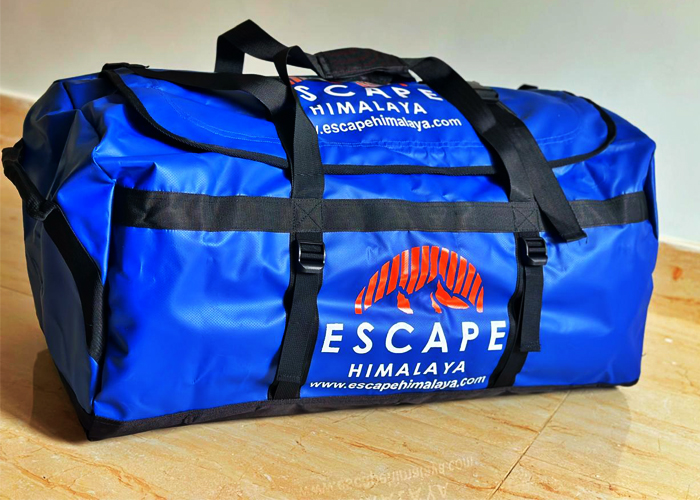
We provide a 120-liter Duffel Bag for trek packing, a certified -20°C Down Jacket, and a four-season Sleeping Bag, ensuring warmth and coziness during chilly mountain nights.
Trekking Duffel Bag
A duffle bag, also known as a kit bag is a cylindrical-shaped carrying bag having a top closure generally made of either natural fabric or other sturdy fabric (usually canvas). It has a handle or a shoulder strap to carry which makes it easy for the porter to carry it. Duffle bags are commonly used for traveling, sports, and outdoor activities or even for temporary storage. They are used for carrying clothing, personal items, and electronics or sports gear during travel. The size of the duffle bag varies according to one's needs and requirements. They come in different sizes from small bags to large travel duffle bags capable of holding required gear during travel. Generally, duffle bags are used to carry loads up to 15 kg in all trek which varies according to the size and materials to be carried during the travel, as well as the carrying limit of the porter. Duffle bags are suitable for trekking due to their comfort and accessibility as it is flexible and portable which makes them easy to carry. It is an excellent choice to carry for traveling due to its versatility and ease of handling.
Trekking Duffle Bag
We arrange the duffle bags that hold up to 120 liters of storage capacity and are also waterproof which helps in the rainy environment by protecting the materials inside the bag. Generally, these duffle bags are carried by the porter during the trek and you can carry a small or medium carrying bag for yourself to carry personal materials and gadgets with you. Please be assured that your luggage and suitcase will be securely managed and safeguarded at our hotel while you enjoy your trek and will promptly return to you once you complete your trek.
Down Jacket
A down jacket, also known as a puffer jacket is a quilted coat filled with soft feathers either from a duck or goose. Down jackets are more popular for cold climates and especially useful in mountains and higher altitudes. They are generally preferred by hikers, trekkers, and backpackers for being extremely comfortable due to their lightweight and compressibility making it easy to pack without occupying a lot of space. It has an excellent warmth-to-weight ratio, best for maintaining body heat essential for trekking in cold climates and higher altitudes.
It is also ideal for wearing and sleeping in during high-altitude treks, providing excellent insulation and good comfort. Please ensure to return it once the trek is completed so it can be preserved for the next adventures.
Sleeping Bag
Sleeping bags are essential gear for travelers and trekkers which provide good comfort and protection in various climatic conditions and altitudes. Most of our treks and tours require a sleeping bag as it keeps you warm by trapping the heat around you from your body.
The sleeping bags we use are mummy-shaped with a zip up and down that keeps the top tight around you. It is used in cold and wet climates in high altitudes( -20°C to -25°C maximum temperature) giving you protection, and comfort and as well it is also lightweight and compact which it easy to carry on long treks. The sleeping bag is returned after the trek as it helps us to maintain our gear for future adventurers.
At Escape Himalaya, we provide a detailed checklist of essential trekking gear, ensuring that you're fully equipped for your Himalayan adventure.
At Escape Himalaya, we provide a detailed checklist of essential trekking gear, ensuring that you're fully equipped for your Himalayan adventure.
HEAD
Sun Hat or Scarf
Lightweight Balaclava or Warm Fleece Hat
Sunglasses with UV Protection
Headband or ear covers
FEET
Thin, Lightweight Inner Socks
Thick, Warm Wool Hiking Socks
Sturdy Hiking Boots
Camp Shoes (Sneakers/Sandals)
Gaiters
Spare Laces
Microspikes
HANDS
Lightweight Gloves
Heavyweight Gloves or Mittens
Hand Warmers
LOWER BODY
Undergarments
Hiking Shorts
Lightweight Cotton Long Pants
Light & Expedition Weight Thermal Bottoms
Fleece Pants
Waterproof Shell Pants
ACCESSORIES
Backpack (30-50 LTR)
Headlamp
First Aid Kit
Large Plastic Bag
Trekking Poles
Water Bottle
Toiletries
Lip Balm
Water Purification Tablets
Dry Bags/Ziploc Bags
Earplugs
Guide and Porter
Chargers
Bag Covers
Raincoat
Personal Care Kit
Sunscreen
Moisturizer
Personal Hygiene Items
Wet Wipes
Tissues
Handwash
Blister Plasters
Portable Hand Sanitizer
ADDITIONAL ITEMS
Maps and Guides
Snacks/Energy Bars
Camera
Notebook/Pen
Prepare for your Everest Heli Shuttle Trek with confidence, knowing that you have all the necessary gear and essentials to make your journey safe, comfortable, and memorable.
FAQs: Everest Base Camp Heli Shuttle Trek
1. What is the Everest Base Camp Heli Shuttle Trek and how is it different from the standard EBC Trek?
The Heli Shuttle Trek follows the full classic EBC route on foot from Lukla all the way to Kala Patthar (5,545 m) and Everest Base Camp (5,364 m). Instead of walking back to Lukla over 3 to 4 days, a shared helicopter from Gorakshep brings you back in 15 to 20 minutes. You experience every stage of the trail and save nearly a week compared to the full return on foot.
2. How does the shared helicopter from Gorakshep to Lukla work?
The helicopter departs Gorakshep on a sharing basis. Above 4,500 meters, helicopters can take off with a maximum of three passengers due to thin air. If the group has more than three trekkers, the first shuttle takes three to Pheriche, the helicopter returns for the rest, picks up the first group, and continues to Lukla. The full flight takes 15 to 20 minutes. Private charter is available at additional cost.
3. Why is the minimum group size two trekkers on this package?
The minimum of two is directly linked to the shared helicopter logistics from Gorakshep. A single trekker on a shared helicopter may end up covering an unfilled seat at full charter cost. Two trekkers ensures the cost sharing works as planned. Solo trekkers can join a departure with other booked trekkers or opt for a private charter. Contact Escape Himalaya for current availability on specific dates.
4. What peaks are visible from Kala Patthar?
From Kala Patthar at 5,545 meters, the view covers Mount Everest (8,849 m), Lhotse (8,516 m), Nuptse (7,861 m), Changtse (7,543 m), Khumbutse (6,636 m), Lingtren (6,749 m), Pumori (7,161 m), and Ama Dablam (6,812 m). The sunrise at Kala Patthar is the most complete view of Everest's south face available on any trekking route in Nepal without a climbing permit.
5. Is the Everest Base Camp Heli Shuttle Trek suitable for beginners?
Yes, with the right preparation. The trail is well-marked and does not require technical skills. Daily walking covers 10 to 14 kilometers over 5 to 8 hours. The main challenge is altitude, not the physical difficulty of the trail. The two acclimatization days at Namche and Dingboche are built specifically to manage this. Trekkers who walk regularly and have done some hill or stair training before departure handle the route well.
6. What happens if the Lukla flight is cancelled due to weather?
Lukla operates on visual flight rules only, so poor visibility grounds all flights. Escape Himalaya monitors conditions in real time and contacts trekkers before they leave the hotel if a delay is likely. During peak season, flights operate from Ramechhap which has a longer clear-weather window than Kathmandu. Keeping one spare day at each end of the trip is strongly recommended to protect the international return flight.
7. Is travel insurance mandatory and what altitude should it cover?
Yes, travel insurance is mandatory for all Escape Himalaya treks. For this trek, the policy must cover helicopter evacuation and medical treatment to at least 5,600 meters, which covers both Kala Patthar and Everest Base Camp. It should also cover flight cancellation and trip interruption. Confirm the altitude coverage limit before purchasing, as many standard adventure policies cap at 4,000 or 5,000 meters.
8. What is included in the helicopter fare from Gorakshep to Lukla?
The private helicopter from Gorakshep to Lukla is included in the Escape Himalaya package price. It covers the shared helicopter flight on the Day 10 return from Gorakshep after the Kala Patthar hike. The subsequent Lukla to Kathmandu fixed-wing flight is also included. If a private charter is preferred instead of the shared helicopter, this is available at an additional cost confirmed at the time of booking.
9. How much spending money do I need for personal expenses on the trail?
Budget approximately NPR 2,500 to 4,000 per day for personal expenses. This covers hot showers (NPR 300 to 500), device charging (NPR 100 to 300), Wi-Fi via Everest Link or Airlink cards (NPR 700 to 800 per 24 hours), bottled water (USD 1 to 3), and snacks. For the full 10 trekking days, total personal spend typically runs USD 150 to 250 per person. Withdraw cash in Kathmandu, not at the Namche ATM.
10. What is Tengboche Monastery and is it included in the itinerary?
Tengboche Monastery at 3,860 meters is the largest and most significant Buddhist monastery in the Khumbu region. Founded in 1916 and rebuilt after a 1989 fire, it sits on a ridge with a direct view of Ama Dablam and the Everest massif. The trek passes through Tengboche on Day 5 and trekkers can attend the morning or evening prayer sessions at no cost. A visit takes around 45 minutes to one hour.
11. What is Nagarjun Hill and why is it part of the acclimatization day?
Nagarjun Hill at 5,100 meters is the acclimatization hike from Dingboche on Day 7. It follows the principle of climbing higher during the day and returning to sleep lower, which helps the body produce more red blood cells and adjust to lower oxygen levels. The views from the top cover Makalu (8,463 m), Ama Dablam (6,856 m), Lobuche East (6,119 m), and Taboche (6,367 m). The round trip takes around 6 hours and is a genuinely rewarding hike rather than just a preparation day.
12. Can I extend this trek or combine it with other Khumbu routes?
Yes. Escape Himalaya can customise the itinerary to add extra days in the Khumbu region before the helicopter return. Popular extensions include a visit to Gokyo Lakes via Cho La Pass or additional days exploring the upper valley. For trekkers who want the helicopter return to go directly to Kathmandu rather than Lukla, theEverest Base Camp Heli Return Trek covers exactly that. For a longer Khumbu journey without any helicopter component, thestandard Everest Base Camp Trek runs 16 days.
13. What are the permits required for this trek and are they included?
Two permits are required: the Sagarmatha National Park Entry Permit (NPR 3,000 per person for foreign trekkers) and the Khumbu Pasang Lhamu Rural Municipality Fee (NPR 3,000 per person). Both are included in the Escape Himalaya package price and managed before the trek begins. Permits are checked at the Monjo checkpoint on Day 3 before entering the national park.
14. What gear does Escape Himalaya provide for this trek?
The package includes a 120-liter duffel bag (carried by the porter on the trail), a down jacket rated to minus 20 degrees Celsius, and a four-season sleeping bag rated to minus 20 degrees Celsius. These are on loan for the duration of the trek and returned at the end. Trekkers need to bring their own daypack, boots, clothing layers, and personal items. A full packing list is available on theEscape Himalaya Equipment Checklist.
15. What is the Thukla Pass memorial and why do trekkers stop there?
On the walk from Dingboche to Lobuche on Day 8, the trail passes through the Thukla Pass at 4,620 meters. A collection of stone memorials and cairns at the top of the pass mark the passing of climbers who have died on Everest and other Himalayan peaks, including memorials for Scott Fischer and other members of the 1996 Everest disaster. Many trekkers take time here. The memorial site is one of the more quietly significant stops on the entire Khumbu trail.
16. How does the Khumbu Glacier look from the helicopter compared to from the trail?
From the trail at ground level, the Khumbu Glacier is visible as a wide field of ice and rock debris below Gorakshep. The Khumbu Icefall above Base Camp is visible but its scale is hard to judge without a reference point. From the helicopter at altitude, the glacier's full length becomes visible, the crevasse patterns across the icefall are clear in detail, and the way the ice flows from the Western Cwm between Everest, Lhotse, and Nuptse makes sense as a system. Most trekkers say this aerial perspective completely changes how they understand what they walked through.
17. What is the Khumbu Icefall and can I see it from Everest Base Camp?
The Khumbu Icefall is the most technically dangerous section of the standard South Col route to Everest's summit. It sits directly above Base Camp between the Western Cwm and the valley floor, and during climbing season (April and May), the route through it is marked with fixed ropes and ladders. From Everest Base Camp at 5,364 meters, the lower section of the icefall is clearly visible above the camp. The scale of the ice towers and crevasses is striking from Base Camp, and the helicopter return flight passes directly over this section giving a full aerial view.
18. What should I pack in my 10 kg Lukla flight bag versus leaving in Kathmandu?
The Lukla flight allows 10 kg checked baggage and 5 kg hand carry, strictly enforced. The 120-liter duffel provided by Escape Himalaya is the trail bag and does not go on the plane. For the flight bag, pack: clothing layers for all temperatures (down jacket provided by Escape Himalaya), personal documents, medication, camera, and toiletries. Leave non-trekking items at the Kathmandu hotel storage, which most hotels provide free of charge for the trek duration.
19. Can I upgrade the accommodation on this trek?
The standard package uses the best available twin-sharing teahouse accommodation with attached bathrooms at Lukla, Phakding, and Namche. Above Namche, shared facilities are standard across the Khumbu at all price points. Upgrades to single rooms are available at some teahouses for an additional nightly fee, arranged through the guide. For a fully upgraded accommodation experience across the whole route, theEverest Base Camp Luxury Trek uses premium lodges throughout.
20. What is the cancellation and booking policy for the Heli Shuttle Trek?
A 20 percent deposit secures the booking and confirms the departure date regardless of group size. Cancellation terms vary based on notice period: 30 days, 15 days, and 7 days before departure each carry different refund structures. Weather-related Lukla flight cancellations and helicopter delays are handled separately from standard cancellation policy. Contact theEscape Himalaya team for the full policy details and to confirm group availability on specific departure dates.
The Everest Base Camp Heli Trek was a perfect package for me as it coincided so well with my short schedule at Nepal that I could not stop myself. My correspondence with Escape Himalaya at the very beginning of the trek also helped me greatly in going ahead with it.…
FAQS
Expand All (16)
Q1. Do we need a visa before coming to Nepal?
Yes, most travelers need a visa to enter Nepal. However, the process for obtaining a visa depends on your nationality. You can either obtain a visa from the diplomatic consulate office of Nepal in your respective country or apply for an “On Arrival” visa at the entry checkpoints of Nepal. Please click this link to get more information on ways to issue a tourist visa. Also please see the visa fee here below:
On-Arrival Visa Fee at Entry Points of Nepal:
15 Days – 30 USD
30 Days – 50 USD
90 Days – 125 USD
Indian nationals do not need to have a visa to enter Nepal however they need to bring an official document such as a Passport or Election card (issued by the Election Commission) that proves their identity.
Q2. Which one is better: Group or Solo (private) trek?
Escape Himalaya offers both group and solo trek to Everest Base Camp. However, to choose to join which tour style completely depends upon the traveler itself.
If you are happy to meet people from other parts of the world and join in an experience of a lifetime with fellow travelers, then going for a group trek is also best.
However, if you prefer freedom and flexibility, trekking solo (private) will give you the independence to set your own pace and choose your itinerary. You will have the flexibility to make spontaneous decisions. You will not be bound by a group schedule and choose to lead your journey as you wish and even modify the plan if needed.
Q3. How challenging is trekking to Everest Base Camp?
The trek to Everest Base Camp is moderate to challenging due to the high altitude, cold weather conditions, and the need for acclimatization. The trek involves several days of walking, and the terrain can be steep and rocky at times. Altitude sickness is a potential risk, so it's important to acclimatize properly, stay hydrated, and be aware of your body's signals.
The trek usually takes around 12 days from Lukla to Everest Base Camp and back, covering approximately 130 kilometers (80 miles). The altitude at Everest Base Camp is over 5,300 meters (17,500 feet), and the thin air can make physical exertion more demanding.
Even though the trek brings its challenges its adventurers, stunning landscapes and the sense of accomplishment that comes with reaching Everest Base Camp is worth every step taken. Proper preparation, including physical conditioning and acclimatization, is key to making the journey more manageable.
Q4. When is the best time to go for Everest Base Camp trekking?
The best time to go for Everest Base Camp trekking is during the pre-monsoon (spring) and post-monsoon (autumn) seasons. These are some of the ideal times for exploring the trails as they offer favorable weather conditions and stunning mountain scenery of Everest massif.
Spring season which runs from late April to early June offers mild temperatures, blooming rhododendrons, and clear skies. It is a pre-monsoon as well as post-winter season so the weather is much more favorable and the mountain backdrop and the trails are much more enjoyable for trekking activities. Also, the trail to Everest Base Camp is vibrant with trekkers coming from all parts of the world to witness the glorious mountain scenery and lively trek route.
Autumn season is another best time to do the Everest Base Camp Trek. It lasts from late September to early November and these periods offer stable and clear weather with cool temperatures. These periods also bring a large number of trekkers as the weather is relatively stable, with excellent visibility, offering breathtaking scenes of the Himalayan peaks.
As per trekking during winter and summer/monsoon seasons, these are the least preferred times to do the trek. Winter season which is from November to early March, the weather is extremely cold, and thick layer of snow is another challenge. Nevertheless, one can tackle these challenges with the proper gear. Winter despite being an unfavorable time to do the trek, showcases one of the best vistas of the mountains with clear skies and a peaceful atmosphere with less crowd.
Summer/Monsoon which lasts from June to September grants scenes of green landscapes with blooming flowers and vibrant vegetation along the trails. However, the challenge of flight delays and cancellations with rain is the great challenge of trekking in these times. If you are looking to trek with few crowds, it is the best time but you need to be prepared with the right gear, knowledge, and flexible schedule.
Above all, despite what different season holds, trekkers are always requested to check in with an informed person for the latest weather information before planning a trip.
Q5. How to prepare for Everest Base Camp trekking?
As Everest Base Camp trekking is a moderate to challenging trekking activity, some sort of prior preparation is needed. That being said, you do not have to have trekking experiences. No prior experience is needed yet it is a bonus if you have any. Nevertheless, if you are a beginner or looking to trek Everest Base Camp, you can prepare by doing physical exercises and by being mentally prepared.
For physical preparation, one can encompass cardiovascular exercises, strength training, and endurance workouts. Running, hiking, cycling, and swimming all help in improving cardiovascular condition by strengthening the heart, making it more efficient in pumping blood throughout the body. It also helps in enhancing lung function improving efficiency of oxygen exchange during physical exertion. As the air pressure is low in the mountain region, it is very important to acclimatize properly before continuing the journey. Moreover, cardiovascular activities help in ascending and descending more easily as Everest Base Camp trekking is mostly about hiking up and down.
And as per mental preparedness, is equally important because trekking at high altitudes can be mentally challenging. So, develop a positive mindset and habit of being motivated. Also, one must be aware of their body and not ignore the issues if they are facing any.
Along with physical and mental preparedness, trekking must also be familiar with their trekking gear beforehand. Oftentimes, new gear such as boots do not offer the same comfort as the old ones. Similarly, do not miss out on essential items such as trekking poles, sunglasses, and sunscreen as they are very precious throughout the trek. Prepare your gear as the trek gear recommended by the trek operators.
Remember to start your preparation well in advance to gradually build up your fitness and make necessary arrangements. It is crucial to be well-informed and be prepared for a safe, enjoyable, and smooth trek.
Q6. How to deal with mountain sickness during Everest Base Camp Trekking?
There are challenges on any high-altitude treks. While challenges such as rugged paths, ascents, and descents are there, another crucial one is altitude sickness. Although not everybody suffers from it, one needs to become prepared and aware of it. One of the easiest ways to get altitude sickness is by not properly acclimatizing while ascending higher altitudes. Thus, it is essential to trek gradually. Symptoms like headache, nausea, vomiting fatigue, dizziness, and shortness of breath should not be ignored. If someone is suffering from it, talk to your guide, take the doctor's consulted medication if you have any, and if possible do not hike up until you feel better. However, if the trekkers are not feeling well even after performing all the preventive measures, they must be evacuated from the location. For evacuation, emergency rescue helicopters are available and your trek operator will assist you in managing it. When symptoms get severe it is very important to seek professional medication attention. That being said, it is crucial to not panic, you are with our expert and experienced trek guide. They will be assisting you until help is reached. Moreover, trekkers need to follow guide instructions as they are familiar with the trail, its nature, and the conditions.
Q7. How to avoid altitude sickness during Everest Base Camp trekking?
A few things one can do to avoid altitude sickness would be to ignore processed foods and drink alcoholic or soft drinks on the trail. Alongside, approaching the journey gradually is another way to avoid mountain sickness. Likewise, follow the plan, drink plenty of water, avoid foods that upset your stomach, and most importantly do not rush the journey. Similarly, do not ignore any symptoms and immediately take action if you feel uncomfortable. By following these guidelines and being attentive to your body's responses, you can significantly reduce the risk of altitude sickness during the Everest Base Camp trek.
Q8. Is travel insurance necessary for Everest Base Camp Trek?
It is highly recommended for travelers to have travel insurance before beginning their Everest Base Camp Trek. As we know, it is a high-altitude trek involving certain risks thus having travel insurance ensures travelers with coverage for any unforeseen conditions. Henceforth, please purchase nice travel insurance that covers medical emergencies and evacuation as well as trip interruptions. We suggest trekkers purchase a policy that covers any altitude over 5000 meters. And lastly, please do good research about policies before purchasing it.
Q9. How much extra money we should bring for the Everest Base Camp Trek?
The amount of extra money you should carry for the Everest Base Camp trek depends on various factors including your spending nature and trek duration. Your extra cash will be going towards snacks, drinking water, hot showers, electricity, and WIFI. We suggest you prepare about 2500-3000 Nepalese rupees per day while on the trek. Moreover, credit cards are rarely accepted so it is recommended to travel with enough Nepalese rupees. You can exchange your currency at the nearest exchange shops near your hotel area or at the airport.
Q10. Are there any alternative routes to Everest Base Camp Trek?
Yes, there are alternative routes and variations to the Everest Base Camp trek that offer different perspectives, landscapes, and experiences. Classic Everest Base Camp trek with a drive to Phaplu is one of the serene ways to approach EBC. One can also explore other delights of the Everest region by incorporating three high passes. Or one can simply add Gokyo Lake with the Everest Base Camp trek and enjoy the turquoise glacial lake and enthralling Cho La pass. Similarly, to taste the luxury of the mountains, you can simply check out our Everest Base Camp Luxury Trek. Our expert team at Escape Himalaya is available to share our valuable insights and assistance in planning your beautiful journey.
Q11. Is a visa required for entry into Nepal?
Yes, the majority of travelers to Nepal will need a visa. You can acquire one upon arrival at Tribhuvan International Airport in Kathmandu or at land border crossings. Alternatively, you have the option to apply for a visa beforehand at a Nepalese embassy or consulate in your home country.
Q12. Will there be someone to pick me up at the airport when I arrive?
Yes, Escape Himalaya offers airport pickup services for our clients. We recognize the significance of a seamless arrival and strive to guarantee a trouble-free beginning to your journey. When you reserve a trek or tour with us, you can coordinate with our team to schedule a representative to greet you at the airport upon your arrival.
Look for our staff member holding a signboard bearing your name or the company's name for easy recognition. Providing us with your flight details ahead of time, including your flight number and estimated arrival time, enables us to make suitable arrangements for your pickup.
Q13. As a solo traveler, are you able to join a group for your journey?
Certainly! As a solo traveler, you're welcome to join one of the groups organized by Escape Himalaya. We frequently arrange group treks and tours that cater to individuals traveling alone. Joining a group not only allows you to meet other travelers but also offers the opportunity to share experiences and potentially lower costs.
When reaching out to Escape Himalaya, simply inform us that you're a solo traveler interested in joining a group. We'll then provide details about available group departures and assist you in selecting a trek or tour that aligns with your preferences and travel dates.
Q14. What are the types of hotel you use in Kathmandu?
Generally, we use the best available 3-star, 4-star, and 5-star category hotels for travelers' accommodation in Kathmandu. Meanwhile, travelers can upgrade or prolong accommodation with us as required.
The costs to prolong or upgrade hotel accommodation in Kathmandu may vary based on preferred hotel rates.
Q15. Would it be possible for me to upgrade my accommodation to a luxury hotel in Kathmandu?
Certainly! You have the option to upgrade your accommodation to a luxury hotel in Kathmandu. If you wish to elevate your stay from the standard 3-star hotel provided by Escape Himalaya, simply let us know, and we can arrange the upgrade for you. However, please bear in mind that availability and pricing for luxury hotels may fluctuate based on the hotel and the timing of your visit.
Q16. Which destinations are commonly favored by tourists visiting Nepal?
Nepal boasts breathtaking natural landscapes and a profound cultural legacy. Among the sought-after tourist spots are Kathmandu (the capital), Pokhara, Chitwan National Park, Lumbini (the birthplace of Lord Buddha), Bhaktapur, as well as the renowned trekking regions of Annapurna, Everest, Langtang, Manaslu, and Upper Mustang.