Flying to Lukla: Everything You Need to Know Before Your Everest Trek Begins
Ask anyone who has trekked to Everest Base Camp about the most memorable part of the journey, and most of them will mention the Lukla flight before they mention the mountains. Not because it is long or particularly comfortable, but because it is unlike any other flight most people will ever take.
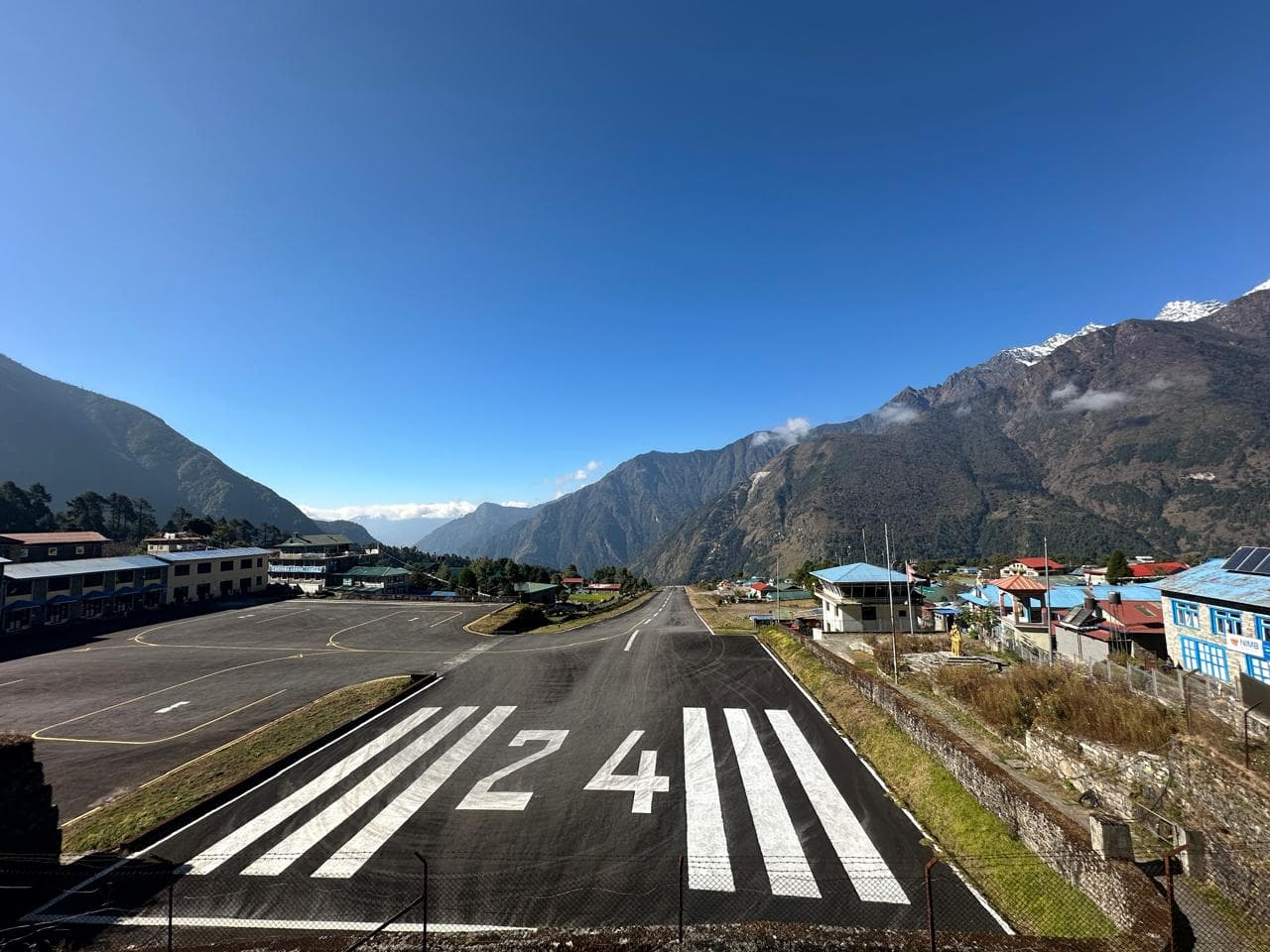
A short sloping runway at 2,860 meters, mountains on three sides, no radar, no night operations, and a 12 per cent gradient, which means you land uphill and take off toward a cliff edge. The whole thing lasts about 30 minutes, and it sets the tone for everything that follows.
Lukla is the air gateway to the entire Khumbu region. Every major Everest region trek, including the Everest Base Camp Trek, the Gokyo Lakes route, the Three Passes circuit, and Island Peak, starts with this flight.
Getting the logistics right before departure matters more than most trekkers expect, especially in peak season when the standard Kathmandu to Lukla route shifts entirely to a different airport 132 kilometres away.
This guide covers everything: how the flight works, which airlines operate it, what happens in peak season, how the Ramechhap reroute works in practice, helicopter options, weather realities, and how Escape Himalaya handles all of it for every Khumbu trek departure.
Tenzing Hillary Airport: What Makes Lukla Different From Every Other Airport
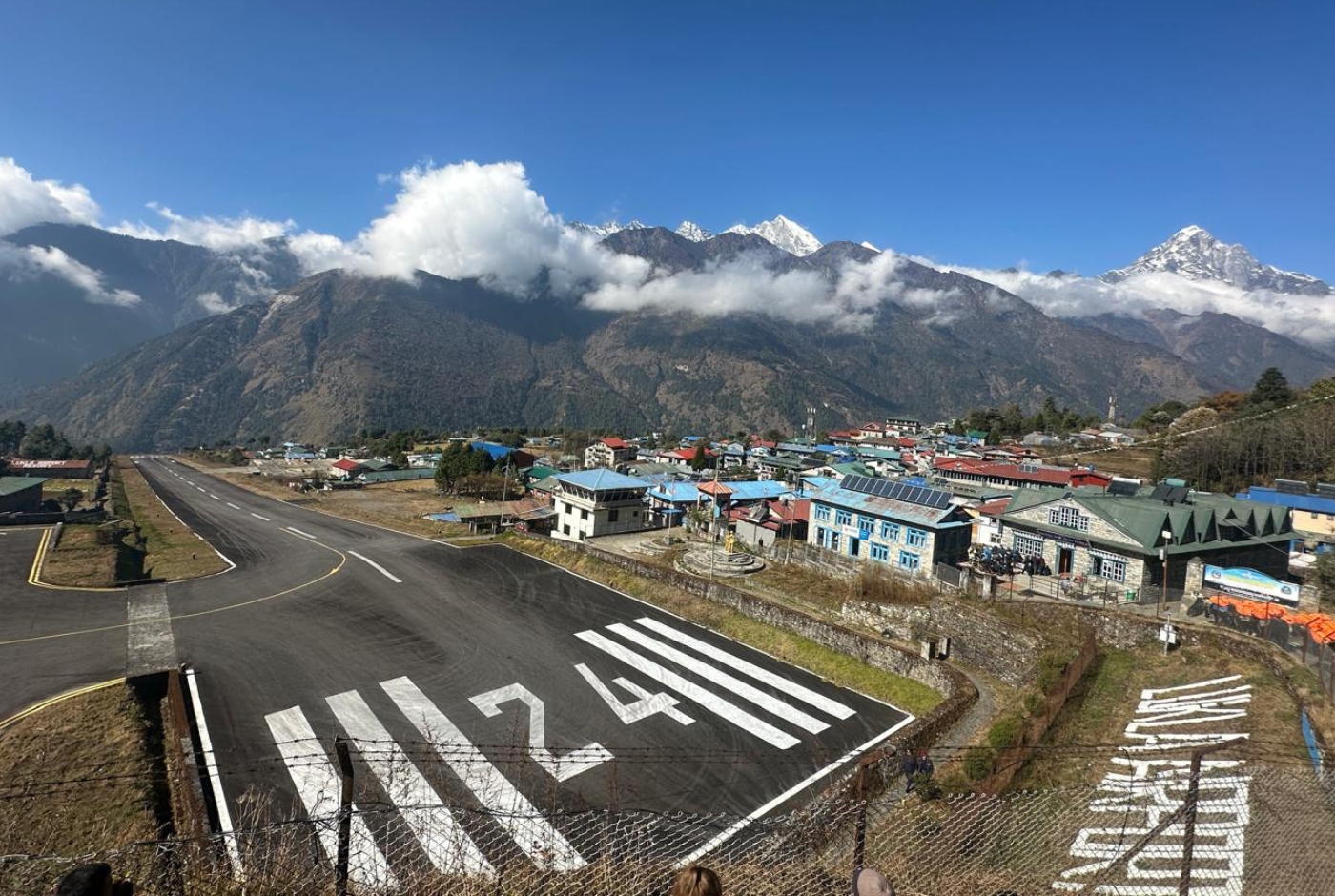
Tenzing Hillary Airport, named after Sir Edmund Hillary and Tenzing Norgay in 2008, was built in 1964 with funding from Edmund Hillary himself as part of his aid work in the Sherpa community. It sits at 2,860 meters above sea level in the Sherpa town of Lukla, in the Solukhumbu district of Nepal.
The airport has a runway of 527 meters with a 12 per cent upward slope on the landing approach. There is no going around if the approach does not look right. Pilots commit to the landing or abort well before the threshold.
The runway ends at a stone wall on the uphill end and drops into a valley on the downhill end, which is why takeoffs run downhill toward the valley, and landings run uphill toward the wall.
A few things make Lukla operationally unique:
- No radar. No instrument landing system. No night operations. Every flight operates exclusively on Visual Flight Rules (VFR), meaning pilots need to see the runway from the air before committing to approach.
- The Nepal Armed Police Force and civil police clear the runway with sirens before every landing and takeoff. No vehicles, no people, no stray animals.
- The weather window for safe operations is roughly 6am to 10am most days. By mid-morning, the wind picks up and clouds build in the valleys below. Most days, if a flight has not landed by 10 am, it does not land at all that day.
- The airport serves as the entry point to Sagarmatha National Park, a UNESCO World Heritage Site covering 1,148 square kilometres of the Khumbu Himalaya.
Despite its reputation as one of the world's most challenging airports, dozens of flights operate safely here every day during peak season.
The risk comes from pushing into bad weather conditions, not from the airport itself. Airlines and CAAN (Civil Aviation Authority of Nepal) have strict protocols around this, and flight cancellations happen regularly precisely because those protocols are enforced.
The Three Ways to Get to Lukla in 2026
Getting to Lukla is not as simple as booking a flight from Kathmandu. The route you take depends on when you are travelling, and peak season changes everything. Here is how each option works.
Option 1: Direct Kathmandu to Lukla Flight
The direct flight from Kathmandu operates during the off-peak months when Tribhuvan International Airport is not at capacity.
- When it operates: December, January, February, early March, June, July, August, and early September. Outside these windows, the Ramechhap reroute typically applies.
- Flight time: 30 to 40 minutes from Tribhuvan International Airport, Kathmandu.
- Departure times: All flights operate in the morning only, typically between 6 am and 9 am. The afternoon weather at Lukla makes flying in later in the day unreliable.
Ticket cost in 2026:
- Foreign trekkers: USD 230 to USD 245 one-way. Recent update
- Nepali nationals: approximately NPR 8,500 one-way
Baggage allowance: 10 kg checked baggage plus 5 kg hand carry. Excess baggage is charged per kg, and the limits are enforced strictly. Pack your main duffel bag to under 10 kg before the flight day.
Booking advice: Even in off-peak months, seats on Lukla flights fill fast. Book at least 4 to 6 weeks in advance. Airlines release tickets in fixed windows, and last-minute availability is not guaranteed. Escape Himalaya books Lukla flights as part of every Khumbu trek package, which means availability is managed well before departure day.
Option 2: Ramechhap (Manthali Airport) to Lukla Flight in Peak Season
This is the option that catches most first-time Everest trekkers off guard. During the busiest months, flights to Lukla do not depart from Kathmandu at all. They depart from Manthali Airport in Ramechhap, 132 kilometres northeast of Kathmandu, which means an early morning drive before you even get to the airport.
Why this happens: Tribhuvan International Airport in Kathmandu handles all of Nepal's international traffic on a single runway. During spring and autumn trekking seasons, the volume of domestic Lukla flights combined with international arrivals and departures creates serious airspace congestion. The morning weather window for Lukla operations is only a few hours long. When dozens of Lukla flights are queuing from Kathmandu alongside international aircraft, many miss that window entirely. Delays stack up, and some trekkers do not get out of Kathmandu for two or three days.
From 2024 onward, CAAN mandated that peak season Lukla flights move entirely to Manthali Airport. Ramechhap sits at only 474 meters above sea level, well below the cloud and wind patterns that affect Kathmandu at 1,400 meters. The airport handles no international traffic, and the VFR window at Ramechhap is longer and cleaner than Kathmandu. Multiple rotations to Lukla can be completed in a single morning with significantly fewer delays.
When it applies: Spring peak season typically runs from mid-March to mid-May 2026. Autumn peak season runs from late September to late November 2026. Exact dates shift year to year, so always confirm with your operator before finalising itinerary dates.
The drive from Kathmandu to Ramechhap:
- Distance: 132 km northeast of Kathmandu via the BP Highway
- Drive time: 4 to 5 hours, depending on traffic and road conditions
- Departure time from Kathmandu: between 1 am and 2 am
The road follows the BP Highway through Dhulikhel and along the Tamakoshi River valley. It is not a particularly difficult drive, but at 1 am in a jeep, it requires an early night before departure.
Flight time from Ramechhap to Lukla: 15 to 20 minutes. Shorter than the Kathmandu flight and often more reliable due to the cleaner weather window.
Cost breakdown:
- Ramechhap to Lukla flight: approximately USD 175 per person
- Shared ground transport from Kathmandu to Manthali Airport: approximately USD 20 per person
- Total: approximately USD 195 per person, which is actually less than the direct Kathmandu flight despite the added logistics
Escape Himalaya manages the full Ramechhap logistics for every peak season trek departure: private vehicle from the Kathmandu hotel, experienced driver, and correct airport arrival timing. Trekkers do not need to arrange a 1am vehicle pickup independently. It is part of the package.
Option 3: Overland to the Solukhumbu Region
For trekkers who want to avoid the flight entirely or who have experienced repeated cancellations and need another option, there is an overland route.
The drive from Kathmandu to Salleri, the district headquarters of Solukhumbu, takes approximately 8 to 9 hours. From Salleri, a 3 to 4-day walk through Phaplu and Kharikhola reaches Lukla on foot. This adds significant time to any itinerary but removes the flight variable entirely.
This option is worth knowing about as a contingency. Escape Himalaya can arrange the full overland and trekking logistics on request for trekkers who prefer this route or who need it due to repeated flight disruptions.
The Three Airlines That Fly to Lukla: Tara Air, Summit Air, and Sita Air
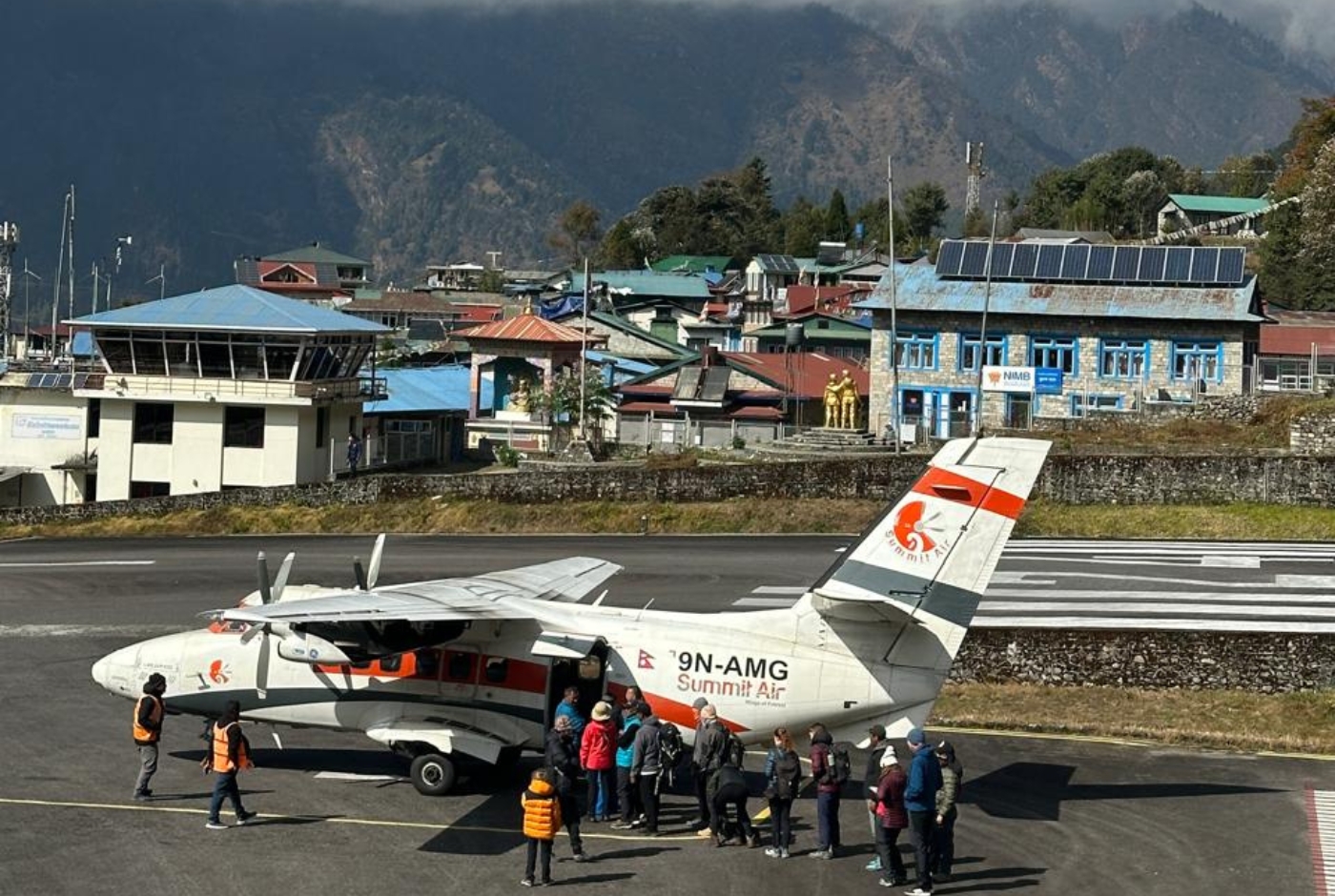
All scheduled flights to Lukla in 2026 operate on one of three airlines. Each uses aircraft specifically designed for short-runway, high-altitude mountain operations, and all three operate on both the Kathmandu and Ramechhap routes depending on the season.
Tara Air
Tara Air is part of the Yeti Airlines group, one of Nepal's most established aviation companies. The airline operates primarily Twin Otter DHC-6 aircraft, a purpose-built Short Takeoff and Landing (STOL) aircraft, primarily with a long safety record in mountain operations across Nepal, Bhutan, and the Himalayas.
Tara Air pilots undergo specific training for mountain flying and have accumulated significant experience on the Lukla route across different weather conditions. The airline operates daily flights during trekking season on both the Kathmandu and Ramechhap to Lukla routes and is one of the most frequently booked options through Escape Himalaya for Khumbu region treks.
Summit Air
Summit Air operates modern aircraft designed for short runways and unpredictable mountain weather. The airline focuses heavily on safety protocols and employs pilots with specific high-altitude mountain flying experience. Beyond passenger services, Summit Air also supports cargo and logistics to remote Khumbu communities, which means the airline's operational familiarity with the Lukla route runs beyond the trekking season.
Summit Air covers both the Kathmandu and Ramechhap routes and is known for reliable scheduling within the morning weather window.
Sita Air
Sita Air is a domestic Nepal airline with a strong reputation for punctual service and customer support on mountain routes. The airline has operated Lukla flights for many years and runs regular scheduled services on both the Kathmandu and Ramechhap routes during trekking season.
A few things that apply to all three airlines:
- All three use aircraft rated specifically for Lukla's 527-meter runway and 12 per cent gradient
- All three operate exclusively on VFR: no instrument flights, no night departures, no bad-weather operations
- Ticket prices are comparable across all three airlines. The choice on any specific date usually comes down to seat availability rather than a significant price difference.
- All three can be booked through Escape Himalaya as part of any Khumbu trek package, including the Everest Base Camp Trek, Gokyo Lakes and Cho La Pass, and Island Peak with EBC.
Helicopter to Lukla: When It Makes Sense and What It Costs
The helicopter is not just a backup option for missed flights. For certain trekkers and certain situations, it is the right primary choice. Here is when the helicopter makes sense and what to expect.
Who typically chooses the helicopter:
- Trekkers on tight schedules with no buffer days who cannot afford a weather delay on Day 1
- Those who have experienced repeated fixed-wing cancellations on a previous visit and want guaranteed departure timing
- Groups who want a more private and flexible departure
- Trekkers who missed a fixed-wing flight due to weather and need to reach Lukla the same day
Flight details:
- Departure point: Tribhuvan International Airport, Kathmandu (no Ramechhap required, even in peak season)
- Flight time: 40 to 45 minutes from Kathmandu directly to Lukla
- Aircraft: Airbus H125, Bell 407, Robinson R66 depending on availability
- Capacity: up to 5 passengers per helicopter (weight dependent)
The views from the helicopter are different from the fixed-wing experience. Flying at a lower altitude gives clearer sightlines of the valleys, Sherpa villages, and river systems below, with the high peaks appearing on the horizon as you approach the Khumbu.
Cost in 2026:
- Group sharing (up to 5 passengers): USD 600 to USD 650 per person one-way
- Private charter (up to 5 passengers): USD 2,500 to USD 3,000 per helicopter one-way
Escape Himalaya can arrange group-sharing helicopter coordination for trekkers who prefer not to manage the booking independently. For trekkers doing the Everest Base Camp Heli Return Trek, the helicopter return from Gorak Shep or Lukla is also available and built into the package itinerary.
Important to know:
- Helicopter flights are still weather-dependent at the Lukla end. They are more flexible than fixed-wing aircraft in marginal conditions, but the Lukla landing itself still requires a clear approach.
- Travel insurance covering helicopter rescue is separate from flight delay or cancellation insurance. Always confirm your policy covers both before departure.
- The helicopter return from Lukla to Kathmandu is a popular option for trekkers who want the full walking experience to Base Camp but prefer to avoid the flight uncertainty at the end of the journey.
Lukla Weather and Flight Delays: What to Actually Expect
The weather is the variable that no itinerary can fully plan around at Lukla. Understanding how it works, what causes delays, and how to minimise the impact helps set realistic expectations before departure.
Why Weather Affects Lukla More Than Other Airports
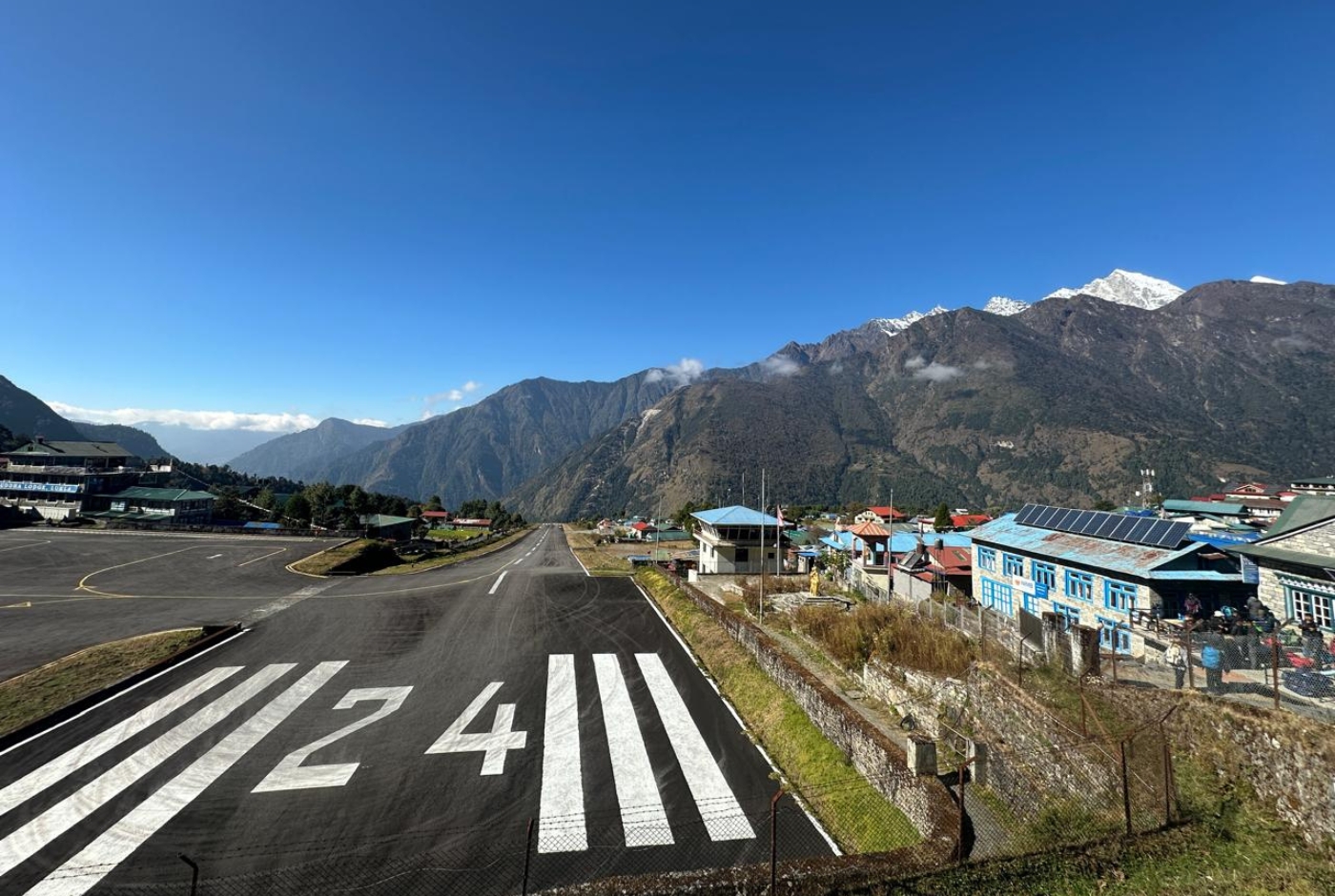
Lukla has no radar, no ILS, and no night operations. Pilots fly on what they can see. The airport sits in a valley with mountains rising steeply on three sides. Cloud develops quickly at valley level and the approach corridor fills with mist fast, sometimes within minutes of conditions changing.
The safe flying window on most days runs from around 6 am to 10 am local time. By late morning, the Khumbu valley winds pick up and clouds push in from the south. Even on days that look clear from Kathmandu, Lukla can be fully closed. This is why trekkers are sometimes surprised by cancellations on what appears to be a perfectly fine morning in the city.
Season by Season: What to Expect
- Spring (March to May): Generally stable with clear morning windows on most days. Afternoon clouds develop daily from late March onward as moisture builds from the south. The Ramechhap route operates during this period, which itself reduces delays compared to the old Kathmandu-only system. April and May are the busiest months, with the highest flight volumes and the most weather variability.
- Monsoon (June to September): The most disrupted period of the year. Heavy rainfall, persistent low cloud, and poor visibility cause frequent delays and cancellations throughout. Any itinerary planned during monsoon months should carry at least two to three buffer days at both the Kathmandu start and the Lukla return.
- Autumn (October to November): The best flying season for Lukla. Clear skies, stable morning windows, and excellent visibility are the norm. Occasional disruptions occur in November as early winter weather pushes in from the north, but most departures in October operate without significant delay.
- Winter (December to February): Cold and often clear. Fewer trekkers mean fewer flights, but the weather windows when they do operate are generally good. The reduced flight volume also means less competition for seats and shorter airport queues.
What Happens When a Flight is Cancelled
Airlines will reschedule to the next available morning or issue a full refund, depending on the circumstances. For trekkers on a booked package, the operator manages rescheduling directly with the airline.
The most important preparation any trekker can make is building buffer days into the itinerary. At minimum, one extra day at the Kathmandu start and one extra day built into the Lukla return is the standard recommendation. Trekkers who leave Kathmandu the morning their trek is scheduled to begin, with no buffer are taking a risk that a single weather day will collapse the entire plan.
Escape Himalaya monitors flight conditions in real time and communicates changes to trekkers before they leave the hotel. In peak season Ramechhap operations, this matters especially: no one drives four hours through the night to an airport for a flight that is already cancelled before they get there.
How Escape Himalaya Manages Lukla Flight Logistics
Every Escape Himalaya trek to the Khumbu region includes a Lukla flight booking as part of the package, not as a separate service to arrange after booking.
The team books with Tara Air, Summit Air, or Sita Air, depending on availability and the departure date. During peak season, the operation automatically shifts to Ramechhap and the full logistics, private vehicle from the Kathmandu hotel, driver, and airport arrival timing for early morning departures, are arranged before the trek starts.
For trekkers who prefer the helicopter, Escape Himalaya arranges both group-sharing and private charter options on request. The team also manages the return flight from Lukla at the end of the trek, including the helicopter return option built into the Everest Base Camp Heli Return Trek.
If a flight is cancelled, the team handles rescheduling directly with the airline and keeps trekkers informed. The itinerary buffer days are built in precisely for this reason and the team knows how to absorb a one-day delay without losing the rest of the trek schedule.
Khumbu region treks where Lukla flight logistics are fully managed:
- Everest Base Camp Trek (16 Days)
- Everest Base Camp Short Trek (14 Days)
- Everest Base Camp Heli Return Trek
- Gokyo Lakes and Cho La Pass Trek
- Island Peak with EBC
- Lobuche Peak with EBC
Practical Tips for Your Lukla Flight
A few things worth knowing before the departure day that make the whole process easier.
Before the flight:
- Book at least 4 to 6 weeks in advance during spring and autumn. Peak season seats disappear fast, and last-minute bookings are frequently unavailable on the exact date needed.
- Confirm whether your departure is from Kathmandu or Ramechhap based on your travel dates. Your operator should clarify this at booking.
- Pack your main trekking duffel to under 10 kg. Excess baggage is charged per kg, and limits are enforced at check-in. A lightweight duffel from Escape Himalaya's gear loan is included in every package, which helps with this.
- Carry your passport, e-ticket, and any pre-arranged permits in your hand-carry bag, not in the checked duffel.
On the day:
- If flying from Ramechhap in peak season, the vehicle from Kathmandu leaves between 1am and 2am. Set multiple alarms the night before and get an early sleep after arrival in Kathmandu.
- Do not assume a clear morning in Kathmandu means Lukla is clear. Your operator or guide will have real-time conditions and will contact you if anything changes.
- Keep the day flexible where possible. Even well-planned itineraries can shift by a day due to Lukla conditions, which is exactly why the buffer day exists.
Travel insurance: Travel insurance covering flight delays, trip interruptions, and high-altitude helicopter rescue is essential for any Khumbu trek. Check that the policy covers helicopter rescue to at least 6,000 meters and includes provision for flight cancellation delays. This is not optional on any trek to the Everest region.
Frequently Asked Questions About Lukla Flights
How much does a Kathmandu to Lukla flight cost in 2026?
The flight costs approximately USD 230 to USD 245 one-way for foreign trekkers on a direct Kathmandu flight. In peak season, the Ramechhap to Lukla flight costs approximately USD 240 plus USD 20 for shared ground transport, totalling per person.
How long is the flight from Kathmandu to Lukla?
It takes around 30 to 40 minutes from Kathmandu and 15 to 20 minutes from Ramechhap during peak season.
Which airlines fly to Lukla?
Tara Air, Summit Air, and Sita Air are the three airlines operating scheduled flights on both the Kathmandu and Ramechhap to Lukla routes.
Why do Lukla flights operate from Ramechhap during peak season?
Tribhuvan International Airport in Kathmandu handles international and domestic traffic on a single runway. During the spring and autumn trekking seasons, the volume of Lukla flights combined with international aircraft exceeds the available morning weather window. CAAN mandated the shift to Manthali Airport in Ramechhap from 2024 onward to reduce delays and cancellations. The Ramechhap airport at 474 meters gives a longer and more reliable VFR window each morning.
Can I take a helicopter to Lukla instead of a fixed-wing flight?
Yes. Helicopter flights from Kathmandu to Lukla operate year-round, including peak season, with no Ramechhap drive required. Shared helicopter costs approximately USD 600 to USD 650 per person. Private charter runs approximately USD 2,500 to USD 3,000 per helicopter for up to five passengers.
What is the baggage allowance on Lukla flights?
10 kg checked baggage plus 5 kg hand carry on most Lukla flights. Excess baggage is charged per kg, and limits are enforced at check-in.
What happens if my Lukla flight is cancelled?
Airlines reschedule to the next available morning or issue a refund. Building at least one buffer day into the start and end of any Khumbu itinerary is the standard approach. Escape Himalaya monitors conditions in real time and communicates changes before trekkers need to leave for the airport.
Book Your Everest Region Trek With Lukla Flight Logistics Sorted
For most people, the Lukla flight is part of the experience: the narrow runway coming into view from the cockpit window, the uphill landing, the sound of the aircraft reversing thrust, and stepping out into cold Khumbu air with the Sherpa town of Lukla around you and the mountains above. It sets the tone immediately.
Getting the logistics right, knowing whether you are flying from Kathmandu or Ramechhap, understanding the weather realities, and having an operator managing the booking and real-time conditions removes the stress from what should be an exciting first day.
Escape Himalaya handles every aspect of Lukla flight logistics for all Khumbu trek packages. Reach out via WhatsApp at +977-9851006121 (Raj) or +977-9851363580 (Suman), or through the contact page to start planning your Everest region trek for 2026 or 2027.