
On the standard Everest Base Camp route, most of the trail is about reaching a place. Tengboche is one of the few stops that is about being in one. The monastery stands on a ridge at 3,867 metres (12,687 feet), where the Dudh Koshi and Imja Khola valleys meet, with Everest, Lhotse, Nuptse, Ama Dablam and Thamserku arranged around the horizon on a clear day. It is the largest gompa in the Khumbu, it has been destroyed twice and rebuilt twice, and it remains the working religious centre for the Sherpa communities of the valley.
This guide to Tengboche Monastery explains where it is, what is known about its history, what the Mani Rimdu festival is, how to get there, when to go, and how to behave once you arrive. Where facts are disputed or change with the season, it says so.
In this guide: location, history, significance, architecture, Mani Rimdu, views and photography, getting there, best time, difficulty and altitude, accommodation, etiquette, the Everest Base Camp context, nearby places, practical tips and FAQs.
Where is Tengboche Monastery located?
Tengboche Monastery (also spelt Thyangboche, and known as Dawa Choling Gompa) is in Tengboche village, in the Khumbu region of Solukhumbu District, north-eastern Nepal. Most references place the village in the Khumbu Pasanglhamu Rural Municipality. It sits inside Sagarmatha National Park, a UNESCO World Heritage Site.
The altitude is usually given as 3,867 m (12,687 ft). Some trekking sites round it to 3,860 m or give slightly different figures, so treat small differences as rounding rather than error.
For orientation on the classic route:
- Namche Bazaar (about 3,440 m) is the Sherpa trading hub and acclimatisation stop below Tengboche.
- Tengboche is the next major stop, reached by a descent to the Dudh Koshi river and a long climb.
- Deboche, a small settlement in forest just below, and Pangboche, further along, lie between Tengboche and Dingboche.
- Dingboche (roughly 4,350 to 4,410 m, depending on the source) is the next overnight stop for most itineraries.
- Everest Base Camp (5,364 m) lies several days further on.
Phortse, which sits on a separate high trail above the Dudh Koshi, is not on the standard Tengboche route, though some itineraries use it as a variation.
The history of Tengboche Monastery
The broad outline is well documented. Details of the founding story vary between sources, so it is worth separating the two.
Widely reported:
- The monastery was established in 1916 by Lama Gulu (Chatang Chotar).
- It has strong ties to Rongbuk Monastery on the Tibetan side of Everest, described as its mother monastery.
- It is generally described as the first celibate monastery of the Nyingma lineage of Tibetan Buddhism in the Khumbu.
- The 1934 earthquake destroyed it, and it was rebuilt.
- On 19 January 1989, a fire attributed to an electrical short circuit destroyed old scriptures, statues, murals and wood carvings. It was rebuilt with the help of volunteers and international donors and formally consecrated in 1993, under the guidance of the present Nawang Tenzing Jangpo, regarded by the community as an incarnation of Lama Gulu.
Tradition and variation:
- Accounts credit Lama Sangwa Dorje, associated with Pangboche, the oldest monastery in the Khumbu, with seeing the site's potential, with a footprint on a rock cited as the sign. This is a religious tradition, not a documented event, and it is retold in different ways.
- Sources disagree about the sponsors, the sequence of leaders after Lama Gulu, and the details of the 1930s rebuilding. This article does not present those details as settled.
Tenzing Norgay, who reached the summit of Everest with Edmund Hillary in 1953, is reported to have been sent to Tengboche as a young man to train as a monk, though he did not stay in monastic life. Expeditions have long stopped here for blessings before heading up the valley.
Religious and cultural significance
For Sherpa communities, Tengboche is not an attraction on a trekking route. It is a functioning monastery where monks follow a daily cycle of prayer, study and ritual, and where lay people from across the Khumbu come for ceremonies, teachings and festivals.
Some of what trekkers see along the way carries meaning that is easy to flatten:
- Prayer flags carry printed mantras and prayers, and are understood to spread them on the wind. They are not decorations.
- Prayer wheels contain mantras; turning them clockwise is a form of prayer. Walk to the left of them so that you pass them clockwise.
- Mani stones are carved with the mantra Om Mani Padme Hum. Pass them on the left, again keeping them on your right.
- Murals and statues inside the temple are objects of devotion, not just art.
A good rule is to treat the monastery as you would any other place of worship that happens to be open to visitors. That attitude is also what makes the visit more rewarding.
Architecture and what to expect on a visit
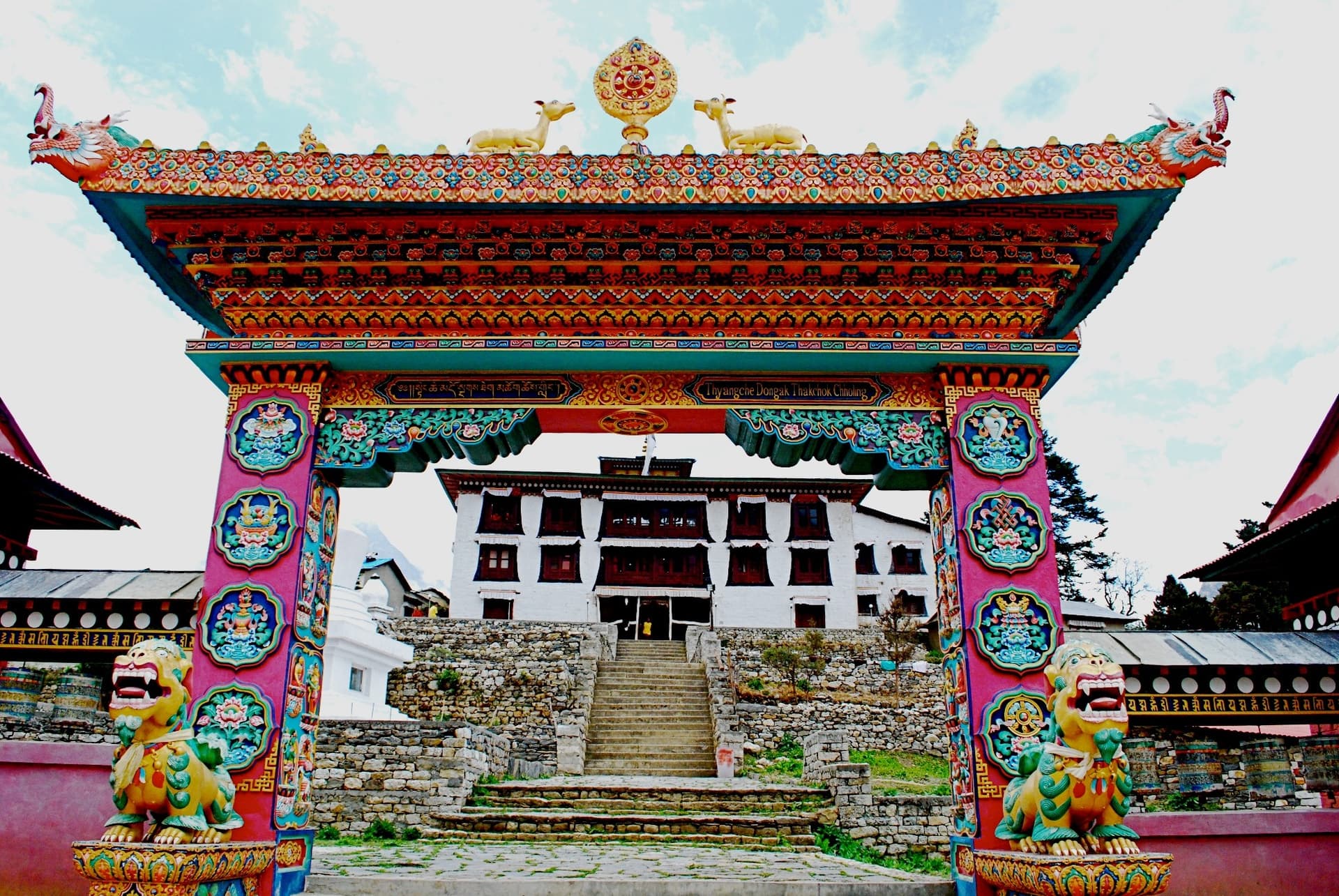
The present buildings are largely a late-twentieth-century reconstruction after the 1989 fire, with carpentry by skilled local craftsmen and murals by artists working in Tibetan Buddhist tradition. Expect a substantial, brightly painted complex with a gateway, a courtyard, the main prayer hall (lhakhang) and monks' quarters. Lodges and camping areas stand nearby.
Visitors are generally able to see the courtyard, and many are able to enter the main hall when it is open, but access depends on the monastery's schedule, ceremonies in progress and season. Do not assume you can enter at any hour, and do not assume the interior can be photographed.
Monks hold daily prayers, usually early in the morning and late in the afternoon, and visitors are often permitted to sit quietly at the back. Timings vary, so ask your guide or lodge host. One trekking blog says morning prayers can begin as early as 4 a.m., which should be treated as an indication rather than a schedule.
Mani Rimdu festival at Tengboche Monastery
Mani Rimdu is the principal annual festival of the Sherpa Buddhist calendar in the Khumbu. It is performed at Tengboche and at other monasteries, including Thame and Chiwong. It is commonly described as honouring Guru Rinpoche (Padmasambhava), who is credited with bringing Buddhism to Tibet in the eighth century. The festival is a religious practice first. The public days include a long empowerment ceremony, ritual dances and a fire ceremony.
What is generally reported:
- A long cycle of private ritual and meditation by the monks comes first. Sources describe a period of about nineteen days.
- The public ceremonies run for roughly three days.
- They include the Wong (empowerment or blessing ceremony), the masked ritual dances called Chham, and a closing fire puja.
- Dates follow the Tibetan lunar calendar, which is why they move across the Western calendar each year, falling in autumn, usually October or November.
A caution about dates. Published dates for 2026 contradict each other: some operators list public days from 26 to 28 October, while others cite early November. Both cannot be right, and none of the pages found cites the monastery itself. For that reason, this article gives no specific year's dates. Before publishing any year-specific date, confirm it directly with Tengboche Monastery, the local municipality, or a trusted local contact, and label it with the year and the date you checked.
Visiting during the festival. Visitors are welcome, but this is worship, not performance.
- Arrive early, sit where you are directed, and do not walk across the dance area.
- Ask before photographing, and follow any restriction on filming specific rites.
- Lodges in Tengboche and Deboche fill early, so book well ahead.
- Expect cold, crowds and a long day.
Mountain views and photography
On a clear morning Tengboche has one of the most celebrated panoramas on the route, with Everest, Lhotse, Nuptse, Ama Dablam, Thamserku and Kangtega commonly named. Ama Dablam in particular dominates the scene, and many photographers regard the monastery gate and courtyard against it as the signature image of the trek.
Practical points:
- Clouds often build up the valley by mid-morning and may cover the ridge by afternoon, so early morning and evening light are the best bets. Do not count on a particular summit being visible.
- Autumn and spring are usually clearer than monsoon or deep winter, though no season is guaranteed.
- Cold drains camera batteries fast; keep spares inside your clothing.
- Ask permission before photographing monks, villagers or anyone in prayer. Some interiors or ceremonies may be off-limits for photography.
How to reach Tengboche Monastery
The usual approach is on foot, via Lukla and Namche Bazaar.
- Kathmandu to Lukla by air. Flights are weather-dependent and delays are common, so build a buffer day into the plan. Check the current departure airport and schedule at the time of booking, because arrangements for Lukla flights have changed in recent seasons.
- Lukla to Phakding, a short first walk (about three hours is typical).
- Phakding to Namche Bazaar, a longer climb that crosses the national park gate at Monjo. Most itineraries add a rest day here.
- Namche to Tengboche, typically 5 to 6 hours at a trekking pace, according to published itineraries. The trail contours, descends to the river near Phunki Tenga, then climbs steeply through forest to the ridge. The final climb is the hard part.
In a standard itinerary, Tengboche is reached on about day five. These are estimates, not guarantees: pace, weather, trail conditions and flights all change the schedule.
Can you visit Tengboche without going to Everest Base Camp? Yes. Some trekkers do a shorter Khumbu itinerary that goes only as far as Namche Bazaar and Tengboche before turning back, and some stay for the festival. The route is the same as the early part of the base camp trek.
Best time to visit Tengboche Monastery
- Autumn (September to November): often clear skies, stable weather and cold nights. This is the busiest season, and Mani Rimdu usually falls here.
- Spring (March to May): warmer days, rhododendrons blooming lower down, and some haze. Also busy; views can be hazier later in the season.
- Winter (December to February): cold, with clear days possible, very cold nights and snow on the trail. It is quieter, but some lodges may close, and serious cold-weather gear is needed.
- Monsoon (June to August): rain, cloud, leeches at lower levels and weather-related flight disruption. There are the fewest trekkers, but views are often hidden.
Mountain weather can change within hours, so treat all of this as a pattern, not a forecast.
Trekking difficulty, altitude and preparation
Tengboche is not a technical destination, but 3,867 m is high enough to matter. The trek is a series of long days with sustained ascents, particularly the climb from the river to the ridge.
- Acclimatise. Spend the planned rest day in Namche, keep to a gradual ascent profile, and do not rush to catch up if a flight delay compresses the schedule.
- Know the warning signs of altitude illness: persistent or worsening headache, nausea, dizziness, unusual fatigue, shortness of breath at rest, loss of coordination or confusion. Do not ignore these. Tell your guide at once and be prepared to descend. Do not go higher with worsening symptoms.
- Drink steadily, eat regularly and avoid alcohol at altitude.
- Kit: broken-in waterproof boots, layered clothing, a warm hat and gloves, sun protection, a good sleeping bag or arrangements for one, and trekking poles for the steep sections.
- Insurance: travel insurance that covers high-altitude trekking and emergency evacuation is essential. Check what is and is not included in the package you choose.
Check current trail conditions and local advisories before departure. Qualified medical advice before travel is sensible if you have heart, lung or other relevant conditions.
Accommodation, food and facilities
Tengboche and nearby Deboche have teahouses and lodges that serve the usual trekking menu of rice, noodles, soups, eggs and tea, and there are camping areas near the monastery. Facilities are basic by lowland standards. Charging, Wi-Fi, hot showers and card payments may be available, often for an extra fee, and they vary by property, season and electricity supply. Prices rise with altitude. Do not rely on a specific amenity: confirm arrangements before departure, and carry enough cash in Nepali rupees.
Monastery etiquette and responsible tourism
- Dress modestly. Cover shoulders and knees, and be ready to remove hats.
- Keep your voice low. Silence is the default inside the hall.
- Take shoes off where there is a sign or where others do so, and follow your guide's lead.
- Do not touch statues, murals, scriptures or ritual objects.
- Ask before photographing people or ceremonies, and respect any ban.
- Do not interrupt prayers or walk between monks.
- Leave a donation if you wish, in the box provided, and treat the amount as a personal choice.
- Carry out your waste, minimise single-use plastic, and respect the national park rules.
- Buy locally from lodges, shops and porters' families when you can.
Tengboche on the Everest Base Camp trek
Most trekkers meet Tengboche as one stage on the way to Everest Base Camp. It is the place where the trek changes character: the Sherpa villages of the lower valley give way to the higher, barer terrain above, and the monastery marks that threshold with a calm night on a forested ridge. It also offers something the base camp itself does not: a living cultural site, rather than a destination reached by effort alone.
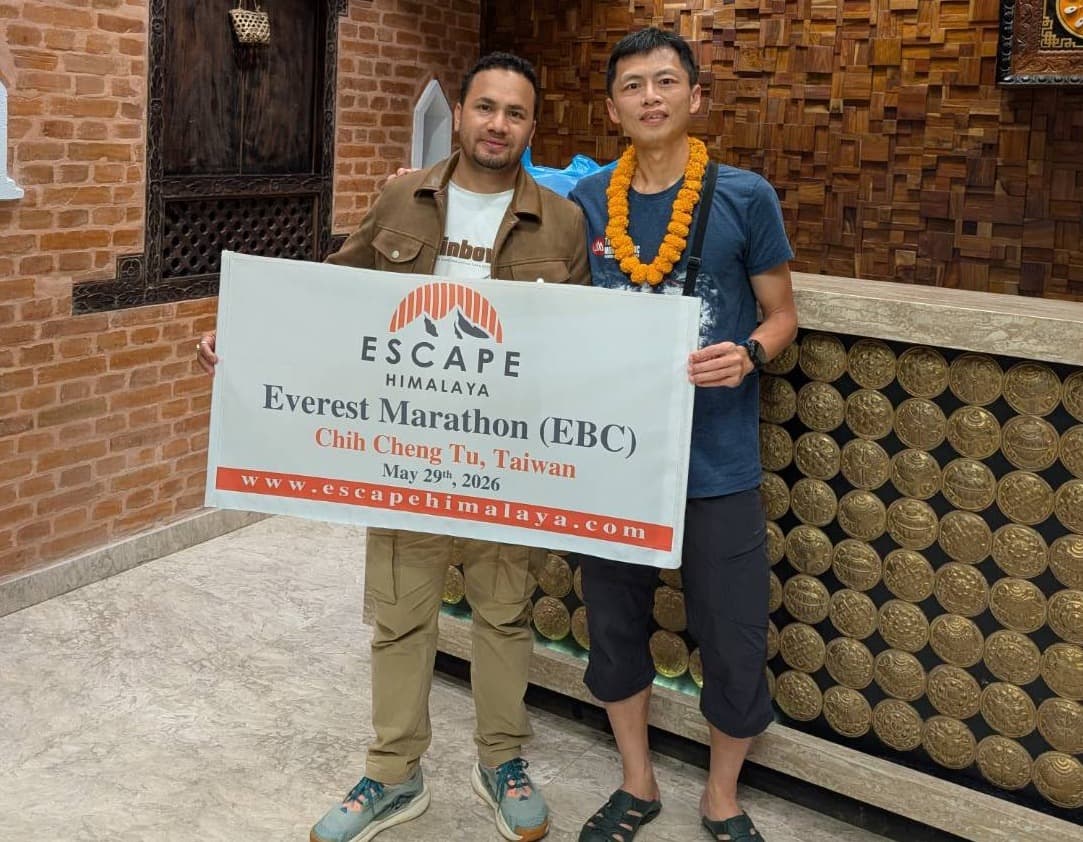
Escape Himalaya's published Everest Base Camp itineraries include Tengboche. Depending on the package, the route is listed as 12, 13 or 14 days.
Other places to explore nearby
- Namche Bazaar: the market town below Tengboche; the usual acclimatisation stop, with a museum and viewpoints. Not a day trip from Tengboche.
- Deboche: a quiet forest settlement, a short walk down, with a small nunnery.
- Pangboche: home to what is regarded as the oldest monastery in the Khumbu, a good extension on the way to Dingboche.
- Khumjung and Khunde: reached by an alternative route from Namche; they add time and are not between Namche and Tengboche on the standard path.
All of these have to be fitted into a realistic itinerary with altitude in mind. Do not try to combine them in a single day.
Practical travel tips
- Cash: carry enough Nepali rupees; ATMs above Namche are unreliable.
- Permits: a Sagarmatha National Park permit and a Khumbu Pasanglhamu Rural Municipality permit are normally required. Fees have been revised before, so check the current amounts. Organised treks typically handle them.
- Clothing: layers, windproof shell, warm hat, gloves.
- Sun: high-altitude UV is strong, so bring sunglasses and sunscreen.
- Water: treat or filter, and refill instead of buying bottles.
- Connectivity: patchy; plan for periods without signal.
- Medication: bring a personal kit and discuss altitude medication with a doctor before travel.
- Flexibility: build in spare days for flight delays and weather.
- Culture: follow the etiquette above.
Entrance fee. Sources conflict: one says NPR 300 at the gate, another says there is none, and others call it small. This article does not state a fee.
Conclusion
Tengboche Monastery rewards the walk it takes to reach it. It combines a mountain setting, a living Sherpa religious tradition, and a place on the Everest route that gives the journey some shape. Go with enough time to acclimatise, respect the practices of the community, and treat the views as a gift rather than a promise.
Planning an Everest-region trek? Explore Escape Himalaya's Everest Base Camp trekking itineraries, or contact the team for help shaping a route that includes Tengboche.
Frequently asked questions
Where is Tengboche Monastery?
In Tengboche village, Khumbu region of Solukhumbu District, Nepal, inside Sagarmatha National Park on the route between Namche Bazaar and Dingboche.
What is the altitude of Tengboche Monastery?
About 3,867 m (12,687 ft). Some sources round to 3,860 m.
Why is Tengboche Monastery famous?
It is the largest gompa in the Khumbu, a long-standing centre of Sherpa Buddhism, the main venue for Mani Rimdu, and a stop on the Everest Base Camp route with views of Everest and Ama Dablam.
How old is Tengboche Monastery?
It was founded in 1916. It was rebuilt after a 1934 earthquake, and again after a 1989 fire, so the present buildings are much newer. It was consecrated in 1993.
How do you get to Tengboche Monastery?
On foot: fly from Kathmandu to Lukla, trek to Phakding and Namche Bazaar, then walk to Tengboche. There is no road.
How long does it take to reach Tengboche from Lukla?
About four days in a standard itinerary, including an acclimatisation day at Namche. Published schedules vary, and delays are common.
Can you visit Tengboche without going to Everest Base Camp?
Yes. Shorter treks go only as far as Namche and Tengboche, and a festival visit is a separate itinerary type.
What is the best month to visit Tengboche Monastery?
October and November (autumn) and April to May (spring) are the usual choices for stable weather and clearer views, though conditions are never guaranteed.
Is there an entrance fee?
Sources differ and this is unconfirmed. Ask locally. The national park and municipality permits are separate and are required for the trek.
Can visitors enter the monastery?
Generally yes, when it is open and no private ceremony is under way, but access varies. Follow your guide and any signs.
What is the Mani Rimdu festival?
The main annual Sherpa Buddhist festival, with a ritual empowerment, masked dances and a fire ceremony over about three public days, timed by the Tibetan lunar calendar.
Can you stay overnight in Tengboche?
Yes, there are lodges and teahouses in and near the village, though they fill quickly during festivals. Confirm ahead.
What mountains can you see from Tengboche?
Weather permitting: Everest, Lhotse, Nuptse, Ama Dablam, Thamserku and others. Visibility varies by day.
Is trekking to Tengboche difficult?
It is moderate but sustained, with a steep final climb and a high altitude. Fitness, acclimatisation and a sensible schedule matter more than technical skill.
What should visitors wear inside the monastery?
Modest clothing that covers shoulders and knees, with hats removed. Follow instructions about shoes.